

If you work in instructional design or L&D, your calendar can fill up surprisingly quickly. There are conferences, webinars, awards, vendor events, certification programs, community meetups, and calls for submissions competing for the same few hours of your attention.
I tend to be selective about them. A good event should give you something you can take back to your work: a design idea worth testing, a useful conversation with another practitioner, a better understanding of where the technology is heading, or a piece of work you can point to later.
For 2026 and 2027, there are several events I’d keep an eye on. Some are large L&D conferences. Others are more useful if you work specifically in digital learning or instructional design. A few allow practitioners to submit their own work for evaluation.
Here are the ones I’d put on the shortlist.
Key eLearning Events to Know About in 2026–2027
| Event | When | Format | Best for |
| ATD Asia Pacific Conference & EXPO | October 27–29, 2026 | Conference + expo | L&D professionals in APAC |
| Learning Technologies Awards | November 11, 2026 | Awards | Learning teams, designers, developers, organizations |
| LEARNTEC | February 2–4, 2027 | Conference + exhibition | Digital learning and education technology |
| Learning Technologies London | May 5–6, 2027 | Conference + exhibition | Workplace L&D and learning technology |
| ATD International Conference & EXPO | May 16–19, 2027 | Conference + expo | Global talent development |
| The Learning Ideas Conference | June 3–4 and June 16–18, 2027 | Online + in-person conference | Learning innovation, instructional design, research |
| iSpring Course Creation Contest | 2026 edition completed (2027 dates to be announced) | Course competition | Instructional designers and eLearning developers |
The list deliberately mixes different types of events. Going to another conference isn’t always the best way to develop your skills. Sometimes entering a competition, submitting a project for an award, or simply reviewing other people’s work can give you more useful feedback.
ATD Asia Pacific Conference & EXPO
October 27–29, 2026 — Taipei, Taiwan

For anyone working in APAC, this is one of the more relevant events on the calendar. The 2026 ATD Asia Pacific Conference & EXPO is being held at the Taipei International Convention Center under the theme “Connected People: Aligning AI and Strategy.”The program focuses on the relationship between AI, organizational strategy, leadership, and talent development.
The event is broader than instructional design alone. That makes it particularly useful if your role also covers learning strategy, training operations, leadership development, or workforce capability.
The conference is designed with an APAC audience in mind, with sessions available in Mandarin and English and AI translation also provided.
My take: If you’re based in Singapore, Malaysia, Taiwan, Australia, Japan, Korea, or elsewhere in the region, I’d look at this before planning a trip to a US conference. Regional events tend to produce conversations about the constraints and work practices you actually encounter in the region.
Learning Technologies Awards
November 11, 2026 — London

Awards are useful for a different reason: they give you a way to examine finished learning projects against explicit judging criteria.
The 2026 Learning Technologies Awards include categories such as Excellence in the Design of Learning Content, Learning Designer of the Year, Learning Developer of the Year, Best Use of AI in a Learning Technologies Project, and Excellence in Accessible and Inclusive Digital Learning.
The criteria are worth reading even if you aren’t entering. The learning-content category, for example, considers the relationship between learning design, cognitive science, media, interactivity, and the performance needed behind the project. The AI category asks entrants to demonstrate how AI addressed a defined learning or performance problem.
I’ve seen plenty of course portfolios where the author spends several paragraphs explaining which tools they used and very little time explaining why the learning experience was designed the way it was. Awards criteria can be a useful corrective because they make you articulate the decisions behind the finished product.
Entries for the 2026 awards are already closed, so I’d treat this year’s categories as preparation for the next cycle.
My take: Read the judging criteria before you build your next portfolio piece. They can be more useful than generic portfolio advice.
LEARNTEC
February 2–4, 2027 — Karlsruhe, Germany

LEARNTEC is one of the larger European events covering digital learning across schools, higher education, and workplace learning. The 2027 edition takes place at Messe Karlsruhe from February 2nd to 4th.
The breadth is useful if your work crosses sectors. The event covers corporate learning, higher education, schools, AR/VR, and new ways of working, alongside the main convention and exhibition.
For instructional designers, I’d pay particular attention to sessions and demonstrations where technology is being used to change the learning experience rather than simply automate content production.
The downside is predictable: large technology exhibitions contain a lot of vendor messaging. I usually treat the exhibition floor as a research exercise rather than a buying exercise. Make a shortlist before you arrive, ask vendors the same questions, and take notes on what you can actually test.
My take: A good choice for European practitioners who want a broad view of digital learning technology without traveling to North America.
Learning Technologies London
May 5–6, 2027 — London

Learning Technologies is one of the bigger workplace learning events in Europe. The 2027 conference takes place at ExCeL London on May 5–6, alongside the exhibition.
This is the event I’d look at if your work sits squarely in corporate L&D. The conference covers learning technology, content design, skills, AI, and broader workplace learning, while the exhibition gives you a chance to compare platforms, tools, and services in one place.
There’s also a useful connection between the conference and the awards: gold winners from the 2026 Learning Technologies Awards are invited to present their winning projects at the 2027 exhibition.
My take: If you can attend only one large European L&D event in 2027, this would be high on my list. The scale means you need a plan, though. Two days wandering between booths without a shortlist is an easy way to come home with a bag full of brochures and very little else.
ATD International Conference & EXPO
May 16–19, 2027 — Boston, US

ATD’s International Conference & EXPO is one of the largest global events for talent development professionals. The 2027 event is scheduled for May 16–19.
This is a broader talent-development event than a dedicated eLearning conference. That makes it particularly relevant to L&D managers and instructional designers who work closely with leadership development, performance, coaching, organizational capability, and talent strategy.
ATD’s international program also gives APAC practitioners a useful way to follow global discussions without relying entirely on local vendor events. The organization also runs dedicated Asia-Pacific programming throughout the year.
My take: Go here for a broader view of the profession. If you’re primarily interested in authoring tools, course-production workflows, and instructional design techniques, there are more specialized events. If you’re trying to understand where L&D as a function is heading, ATD is more useful.
The Learning Ideas Conference
June 3–4, 2027, online; June 16–18, 2027, in New York and online
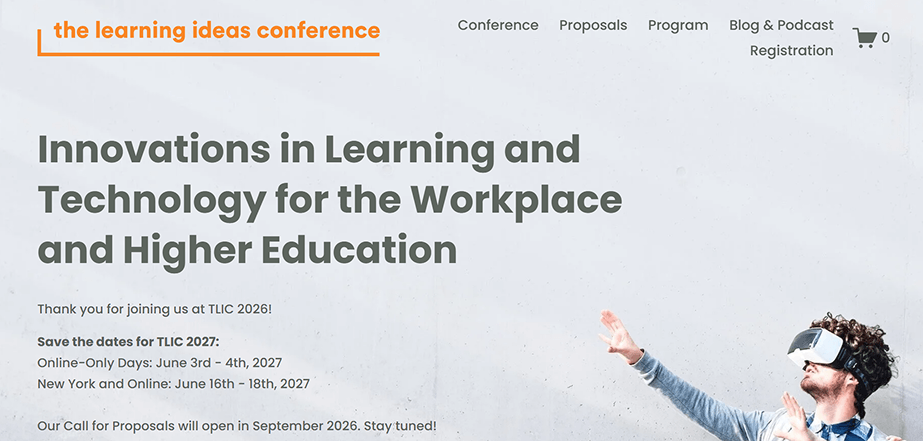
The Learning Ideas Conference is a good option for people who prefer a more cross-disciplinary view of learning technology. The 2027 program includes online-only days in early June and a New York event later in the month, with an online option for the main conference as well.
Its audience spans learning and development professionals, instructional designers, researchers, university faculty, UX designers, and technologists. Topics also include cognitive science, game design, VR/AR/XR, computer science, and other areas that influence how learning experiences are designed.
I like this kind of event because instructional design benefits from looking outside the standard L&D conference circuit.
A UX researcher may give you a better way to think about learner behavior. A game designer may change how you approach feedback. Someone working in cognitive science may challenge an interaction pattern you’ve been using for years.
My take: Put this on the list if you want ideas rather than a tour of the latest LMS features.
Course Creation Competitions
Conferences let you hear how other people work. Competitions give you a deadline to produce something yourself.
That makes course competitions particularly interesting for instructional designers. You have to make decisions about learning objectives, structure, interactions, visual design, assessment, accessibility, and technology, then put the finished result in front of other people.
For someone building a first portfolio, a competition can give you a project to include when you don’t yet have enough client work to show. For an experienced designer, it can create a reason to try a format that would be difficult to justify on a normal production schedule.
iSpring Course Creation Contest
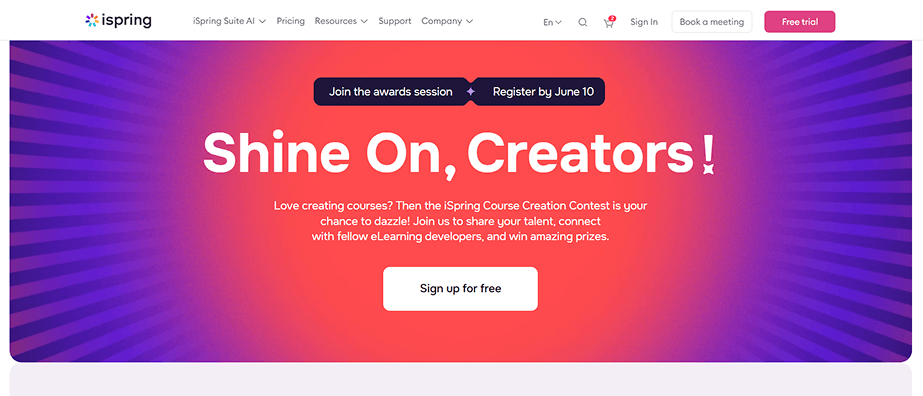
The 2026 iSpring Course Creation Contest is one example of this format. The contest invited aspiring and practicing instructional designers to create eLearning projects in slide-based and scrollable formats. Participants received access to the required authoring tools and learning resources, while the submission process included expert feedback and peer review.
The 2026 edition is already finished, so there is no point treating this as an open call now. I include it because the format is worth watching if you’re looking for future course competitions.
What makes this type of competition useful is the complete project cycle. You take an idea through to a finished learning experience, then let others examine the result. That can expose weaknesses that are easy to miss when you work alone: weak assessment logic, unnecessary interactions, unclear objectives, or visual choices that distract from the content.
The iSpring contest also included opportunities for participants to learn from other instructional designers and receive feedback during the process.
My take: If another course competition with a similar structure opens in 2027, I’d consider entering even if you have no realistic expectation of winning. You can come away with a portfolio piece, hands-on experience, and new connections with other instructional designers.
What I Look for Before Spending Time on an Event
There are more L&D events than anyone can reasonably attend. I use a few filters before putting one on my calendar.
1. Who will actually be there?
“Learning professionals” covers a huge range of jobs.
A conference aimed at CLOs and talent executives may be interesting for an L&D manager but less useful for an instructional designer who wants to improve course design. Likewise, a technical learning technology event may be a poor use of time if you’re primarily responsible for facilitation and leadership development.
Look at the speaker list, session titles, and previous attendees before buying a ticket.
2. Can you see real work?
I put more weight on events that show actual programs, courses, case studies, prototypes, or implementation results.
A session titled “The Future of AI in Learning” tells me very little. A session explaining how a company redesigned a program, what changed, what happened to performance, and what they would do differently is much more useful.
3. Is there a way to participate?
Speaking, submitting a case study, entering an award, joining a workshop, or presenting a project changes the value of an event.
You have to prepare. Preparation tends to produce better learning than passively sitting through presentations.
4. What happens after the event?
Recordings, community access, follow-up sessions, published case studies, and connections with other practitioners can make a three-day event useful for months.
This matters especially if you’re traveling internationally. I wouldn’t spend thousands on flights and lodging for two days of sessions without a plan for using the material afterward.
5. What does the judging actually measure?
This applies to awards and competitions.
Read the criteria before entering. If the judges care about measurable business impact and your project has no evaluation data, you may be entering the wrong category.
If an award is focused on learning design and your application spends most of its space describing the software you used, revise it.
The strongest criteria make you explain the decisions behind the work.
Should Instructional Designers Enter Awards and Competitions?
Yes, selectively.
Awards can be valuable when you already have a strong project with evidence behind it. They can add credibility to a portfolio and give your team something concrete to discuss with stakeholders.
Competitions can be useful early in your career because the project itself becomes evidence of what you can do.
There’s also a practical benefit that gets overlooked: a competition gives you a deadline.
I’ve worked with teams that have plenty of ideas for improving their learning design and very little time to test them. Give the same people a fixed brief and a submission date, and suddenly something gets built.
That’s a useful mechanism for professional development.
The important part is choosing a competition where the judging criteria match the skills you actually want to demonstrate.
How AI Changes the Value of These Events
AI is now part of almost every learning technology conversation. It is also changing what counts as useful evidence of instructional design skill.
Generating a first draft is increasingly easy. Creating quiz questions, narration, translations, summaries, and variations of existing content can all be accelerated with AI.
That makes the decisions behind those outputs more important.
When reviewing a course, I’d want to know:
- Why was this activity included?
- What learner behavior is it trying to change?
- Why does this scenario matter?
- How was the assessment designed?
- What evidence supports the learning approach?
- Where did AI help?
- Where did the designer override or correct it?
- How was accessibility considered?
- How was the final experience evaluated?
The 2026 Learning Technologies Awards criteria reflect some of this shift. The AI category asks entrants to demonstrate a clear learning or performance problem, explain the role AI played in solving it, and provide evidence of impact.
That’s a useful standard for portfolios too.
“I used AI to create this course” tells a potential employer very little.
“I used AI to generate three scenario variations, rejected two because they didn’t reflect the learner’s actual work environment, and tested the final version with 12 learners” tells them considerably more.
From Ideas to Practice
Events are useful when they change what you do afterward.
If a conference gives you a new course format to test, a competition gives you an idea for a portfolio project, or an awards shortlist shows you a design approach worth studying, the next step is to build something.
For instructional designers who want to turn those ideas into a course, choosing the right authoring tool is part of the process. This LMS Chef guide to free eLearning authoring tools compares several options for getting started with course creation and experimentation.
The point is to turn ideas from the event calendar into something you can actually test.
My Shortlist for 2026–2027
If I were planning my own professional calendar, I’d divide these events by purpose.
- For APAC networking: ATD Asia Pacific Conference & EXPO in Taipei is the obvious regional choice for 2026.
- For workplace learning and technology: Learning Technologies London is the one I’d prioritize in Europe in 2027.
- For broader L&D and talent development: ATD International Conference & EXPO has the broadest professional scope.
- For digital learning across different sectors: LEARNTEC is worth considering, particularly for European practitioners.
- For research, experimentation, and cross-disciplinary ideas: The Learning Ideas Conference is probably the most interesting option on this list.
- For building a portfolio: Watch for course creation competitions such as the 2026 iSpring Course Creation Contest and similar calls for submissions.
- For testing your work against a formal standard: Awards such as the Learning Technologies Awards are worth studying even when you’re not ready to submit.
You don’t have to attend everything. Pick one event that exposes you to new ideas, one that puts you in contact with other practitioners, and, if you’re at the right stage in your career, one that requires you to submit something you’ve actually built.
That combination will probably do more for your development than another month of scrolling through “top 10 eLearning trends” articles.
FAQs
What are the best eLearning conferences in 2026–2027?
It depends on what you do. For APAC L&D professionals, the ATD Asia Pacific Conference & EXPO is a strong option for 2026. For European workplace learning, Learning Technologies London and LEARNTEC are worth considering in 2027. The Learning Ideas Conference is a good fit for people interested in learning innovation, research, UX, and technology.
Are there eLearning competitions for instructional designers?
Yes. Course creation competitions periodically invite instructional designers and eLearning developers to submit complete learning projects. The 2026 iSpring Course Creation Contest is one recent example, with slide-based and scrollable course categories and a submission process that included expert feedback and peer review.
Are eLearning awards worth entering?
They can be, particularly when you already have a strong project and evidence of its results. Before entering, check the judging criteria, submission fee, evidence requirements, and whether the award category matches your work.
How can instructional designers build a portfolio without client work?
A self-directed project, course competition, volunteer project, or carefully documented redesign can all give you something concrete to show. A competition can be especially useful because it provides a defined brief and deadline.
What should I look for in an instructional design competition?
Check who can enter, whether the competition is international, what you have to create, which tools you can use, how the judging works, whether feedback is provided, whether your submission becomes public, and what rights you retain over the finished work.
I’d also check whether the judges evaluate instructional decisions or focus mainly on visual polish. Those are very different things.
Are conferences still useful now that so much L&D content is online?
Yes, but I wouldn’t attend a conference simply to collect information. Most of that information is already available online.
The value is usually in the combination of sessions, conversations, demonstrations, informal discussions, and access to people working on problems similar to yours. If you go with three or four questions you want answered, you’re much more likely to come home with something useful.