
Choosing an LMS for employee onboarding and training is one of the few software decisions that shows its flaws quickly. Usually around week three, when new hires ask a question that should have been answered on day one.
I have spent years helping HR teams replace binders and shared drives with something that runs itself, and watched capable platforms fail because nobody mapped the onboarding process first. This review covers the six platforms I keep recommending for effective onboarding. For each employee onboarding LMS tool I looked at what it actually automates, what it costs, and where it annoyed me.
Employee onboarding LMS tool: the six platforms on my shortlist
Every employee onboarding LMS tool on this list can assign a course to a new hire. That is table stakes. What separates them is how much of the onboarding process runs without anyone touching it, and how much evidence you can produce when an auditor asks who completed what.
The stakes are easy to underestimate. Gallup put the cost of replacing an employee at one half to two times annual salary, and estimated voluntary employee turnover was costing US businesses a trillion dollars annually.
Median US tenure was 3.9 years in 2024 according to the Bureau of Labor Statistics, and only 2.7 years for workers aged 25 to 34. Brandon Hall Group research, quoted by almost every vendor here, reports that structured onboarding improves employee retention by 82%. That figure comes from an industry study rather than peer reviewed work, so I use it with the attribution attached, not as an established fact.
LMS features for employee onboarding that actually matter
Most feature lists exist to fill a comparison grid. In practice a handful of capabilities decide whether a learning management system earns its place in employee onboarding.
Automated assignments come first. When new hires appear in the HR system with a job title and a start date, the right onboarding training should show up in their accounts, so new employees are never waiting on an administrator.
Role based learning paths do the sorting. Warehouse hires receive safety and equipment modules, sales hires receive the CRM walkthrough and the pricing rules. Nobody in HR should build enrolment lists by hand, and every hour spent doing so is an hour not spent with new employees.
Progress tracking needs to deliver real time insights rather than a weekly export. A manager who sees completion rates on Tuesday can rescue a stalled onboarding journey on Wednesday, before new hires quietly disengage.
The ability to track learner progress at module level, not just whole course level, makes that possible. Anything coarser tells you onboarding training is late without telling you where it broke.
Compliance training needs an audit trail: which new hires were assigned what, when they completed it, what they scored, and when the required training falls due again. Cheap tools fail quietly here, and you discover it during an inspection.
Mobile delivery closes the list. Plenty of new hires work through their first modules on a phone, at their own pace, before anyone has provisioned laptops for new employees.
If your onboarding content only renders on a desktop, a good share of your onboarding programs will stall in week one. Interactive content matters for the same reason. Quizzes, branching scenarios and other interactive elements hold attention in a way that a PDF of company policies never will.
Connection, culture and the parts an LMS cannot do
A learning management system handles compliance and clarification well, and carries a surprising amount of company culture through video, colleague stories and well made training content.
It cannot manufacture connection. The company culture new hires actually absorb comes from the manager who eats lunch with them in week one, and no employee onboarding process survives the absence of that. Treat the onboarding LMS as the part of the onboarding experience you can automate, not the whole of it.
How I compared these tools
I set up a trial or guided demo on each platform and built the same three role based learning paths: a customer service hire, a field technician and a first line manager. Then I timed how long it took to get the first onboarding path live, and looked at what the reporting features could tell me.
Five criteria carried the most weight. Automation depth, meaning how much of the onboarding process runs on triggers rather than manual effort. Time to a first live onboarding path, because HR teams running onboarding programs rarely have a spare implementation quarter.
Then traceability, the audit trail above. Integration capabilities with HR systems and identity providers. And price transparency, which matters more than price itself when you are building a business case.
Decide early what good looks like. If you cannot track progress against a target, you will not know whether your onboarding programs improved. I ask for two numbers: time to first unsupervised task, and thirty day completion of required training. Both move when digital onboarding replaces traditional onboarding methods.
Every platform here is a full learning management system, not a checklist app, so each carries employee training for new employees well beyond induction. If you only need an equipment request workflow, this is the wrong category of online training software.
I also recorded independent scores from G2 and Capterra in early September 2026. Review volumes move constantly, so read them as a signal of maturity rather than a ranking, and check current figures before you commit.
The shortlist
- TalentLMS. The fastest route from signup to a live onboarding track for new hires, with a free tier that is genuinely usable rather than a crippled demo.
- iSpring LMS. A full onboarding to development platform, strong on automated learning paths and on the job checks for new hires, priced per active user. Renamed from iSpring Learn in late 2025.
- 360Learning. Collaborative authoring that turns internal experts into course creators, with published entry pricing and a genuine continuous improvement loop.
- Absorb LMS. The steadiest option for compliance with heavy employee onboarding at scale, if you are willing to request a quote.
- Docebo. AI driven personalized learning and a deep integration catalogue, aimed at organizations training several audiences from one digital platform.
- SAP Litmos. A large off the shelf library of corporate training, useful when you need compliance training live on day one with no content team.
Employee onboarding LMS software: six platforms reviewed
The reviews below apply the criteria above, in ranked order. I have kept the sections to a similar length so the comparison stays fair, and each employee onboarding LMS software platform gets at least one real limitation. A review that only praises is not a review.
1. TalentLMS
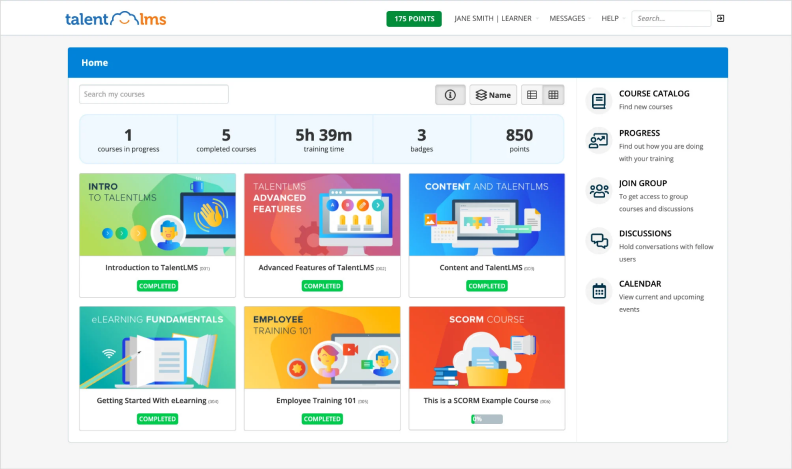
TalentLMS is what I hand to a five person HR team that needs onboarding training live before the next intake. Account setup to the first assigned course took under an hour, and the admin interface is plain enough to hand over after a single session without writing a manual.
Fast to launch, easy to hand over
The onboarding process here is built around course groups and automations. You create a learning path, attach a rule (new user added to the group Warehouse), and new hires land in the right sequence automatically.
Branches let you run separate onboarding programs for different locations under one account, useful for franchises and multi site retail. New employees see the same sequence whichever branch they join. The intuitive platform is the selling point: I have never had to run a second training session for an administrator.
The free plan covers a small number of users and is not a marketing stunt. I have seen companies run an entire onboarding journey on it for a year before upgrading. Paid tiers start at roughly $119 per month for 40 users on annual billing, and the pricing plan is published.
For a first intake of twenty new hires, that speed beats any advanced feature. Onboarding training goes out Monday, completion data arrives Friday.
What you give up for the simplicity
Reporting is the weak point. Completion tracking is fine, but custom reports and the useful analytics sit in higher tiers, and I have exported to a spreadsheet more than once to answer a simple compliance question. Deeper branding is gated the same way.
TalentLMS holds around 4.6 out of 5 on G2 across several hundred reviews, with a similar score on Capterra. That matches practice: teams like it, and meet its ceiling somewhere in year two.
2. iSpring LMS
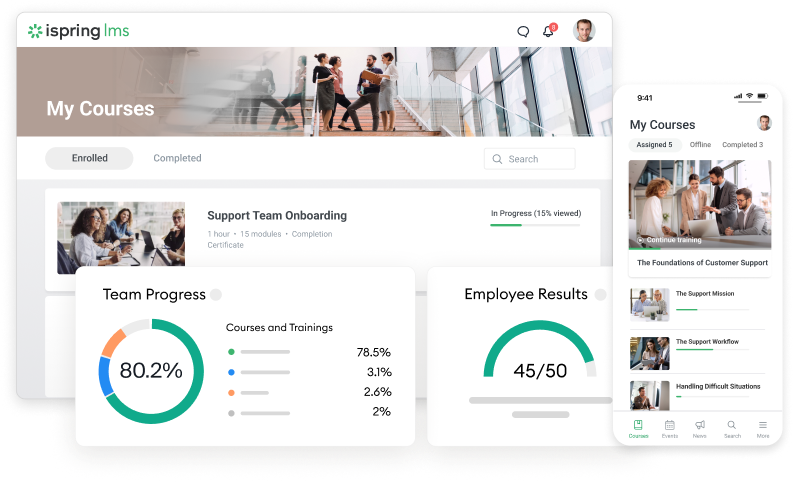
iSpring LMS is what I recommend when employee onboarding is the opening chapter of something longer rather than a one off event. Note the name: the platform was called iSpring Learn until the vendor renamed it iSpring LMS in November 2025, and many comparison pages still list the old name.
Automated learning paths and on the job checklists
Learning tracks are the centre of the onboarding experience. You build a sequence of courses, documents and assessments, then set rules that automate enrollments so anyone added to a group receives the track without HR lifting a finger.
Development plans extend the same structure past the first ninety days, the main reason I place it ahead of tools that stop at induction. AI assisted course creation in the authoring add in also shortens the first build, particularly if your training materials exist as slide decks.
In practice this suits companies where new employees need structured learning paths rather than a catalogue to browse. The role specific training arrives already sequenced, and their onboarding training is waiting when they log in.
The feature I have not seen done as well elsewhere is on the job training with observation checklists. A supervisor works through a structured checklist while watching new hires perform the task, and the result lands in the same record as the quiz scores. For field roles, hospitality and manufacturing, that closes the gap between passing a test and doing the job.
Add a knowledge base for company policies, company culture and onboarding training materials, offline mobile access and a supervisor dashboard that mirrors your org chart, and you have a complete onboarding learning management system rather than a course player.
According to the vendor’s own case study, funeral services group Vertin built three role specific onboarding tracks and reported launching its L&D capability within thirty days, with completion reaching 96% on some courses. Vendor case studies are marketing, so read that as a best case, not a benchmark.
The same caution applies to the widely repeated claim that an LMS cuts onboarding time by 40%. I cannot find an independent study behind it, so I would not put it in a business case.
Pricing is per active user, meaning someone who logged in at least once that month, billed annually. Expect roughly $3.58 to $6.91 per active user per month depending on volume, across a Business plan and an Enterprise plan that adds SAML single sign on, unlimited API access and on premise deployment.
The reporting gap, and the Windows problem
Reporting is the recurring complaint in independent reviews, and my experience matches it. Standard reports cover completion and scores well, but custom reporting is limited and there is no clean route into a BI tool, so I have built spreadsheets I should not have needed.
The authoring add-in, iSpring Suite, also runs on Windows only, which matters if your instructional designers work on Macs. The browser based alternative, iSpring Cloud AI, works on any operating system, though it builds lighter page style courses rather than full PowerPoint based ones. On its own product page iSpring LMS sits at about 4.6 out of 5 on G2, on a smaller review base than TalentLMS or Absorb, so treat it as encouraging rather than decisive.
3. 360Learning
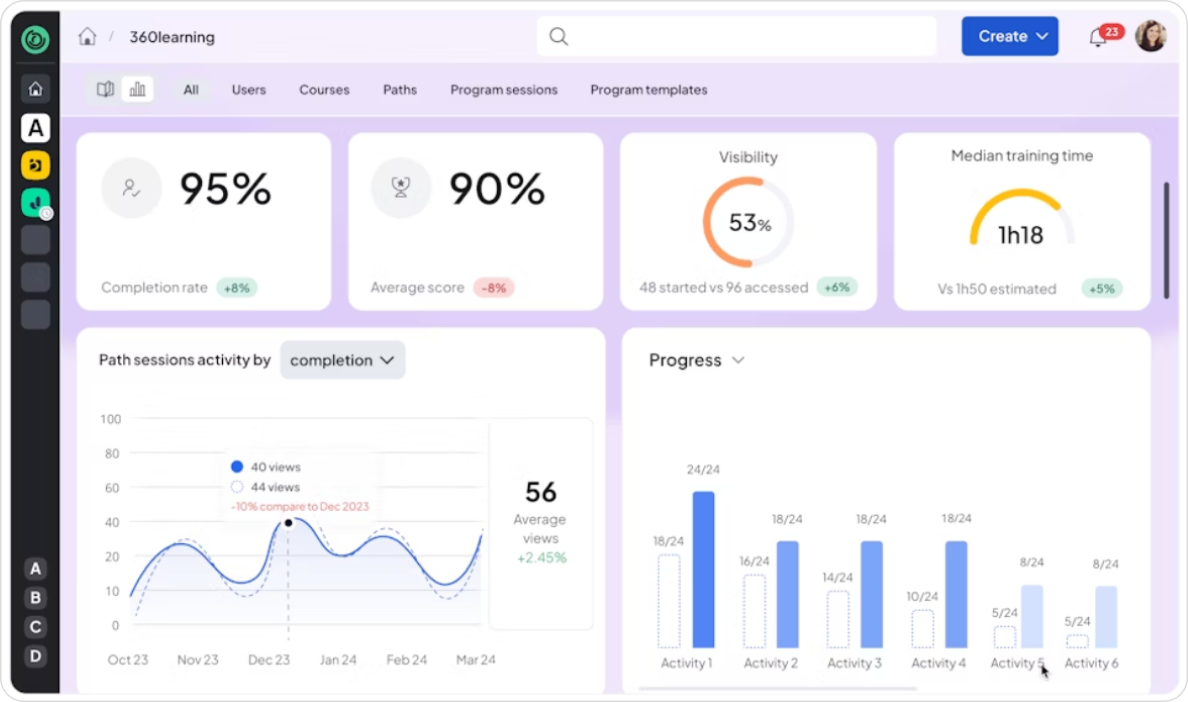
360Learning makes a different bet: your best onboarding content already lives in the heads of the people doing the work, and the LMS should make publishing it easy.
Built for teams that create their own content
Authoring is collaborative and comment driven. A subject matter expert drafts a module, colleagues annotate it in place, and the course improves through use instead of an annual review cycle.
For onboarding programs in fast moving companies, where the onboarding process you documented in March is wrong by September, that continuous improvement loop is worth more than a polished template library. Training materials written by the team that uses them tend to stay current, which is exactly what most onboarding programs fail at, and it gives new employees an onboarding experience that matches the job.
Automation is solid underneath the collaboration. Groups, automated assignments and personalized learning paths all behave as expected, and the platform nudges new employees toward peer discussion rather than solitary clicking, which does measurably more for job satisfaction in the first month. New hires who ask questions in week one tend to stay.
Entry pricing is published, starting around $8 per user per month for a team plan capped at 100 users, so budgeting is straightforward.
Not a turnkey onboarding system
The model only works if your internal experts genuinely contribute. Twice I have watched a rollout stall because the people meant to author the onboarding courses had no time to do it, and no platform fixes that.
If you want a system that delivers required training out of the box with minimal input, this is the wrong shape of tool. Independent scores are strong, close to 4.6 on G2 and 4.7 on Capterra across several hundred reviews.
4. Absorb LMS
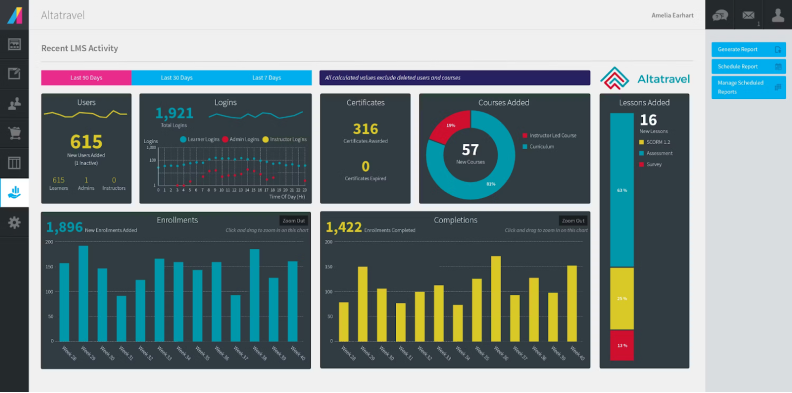
Absorb LMS is what I suggest when the employee onboarding process has to satisfy an auditor as much as it satisfies new hires.
Compliance and scale without the clutter
The admin experience is the cleanest of the enterprise tier platforms I tested. Automated enrolments, recurring required training programs, certification expiry and reporting that a compliance officer can read without a translator.
The learner interface holds up on mobile, and the course player handles SCORM training content from a previous system without the usual migration drama.
For organizations onboarding hundreds of new hires across regions, the combination of granular permissions and dependable reporting features is the whole point. Absorb scores around 4.6 on G2 across roughly eight hundred reviews and 4.8 on Capterra, among the most consistent independent feedback in this category.
Where it shines is repeat volume. If you welcome new employees every fortnight across several countries, the consistency of the onboarding experience matters more than any single feature.
You will have to ask for a price
There is no published pricing plan, and quotes vary widely with user count and modules, so comparing onboarding costs against a mid market tool takes work.
The other friction is initial configuration. The flexibility that makes Absorb good at scale means the first fortnight involves decisions a small HR team may not be equipped to make alone. Budget for implementation support rather than assuming you will self-serve. None of it is visible to new hires, which is the point.
5. Docebo
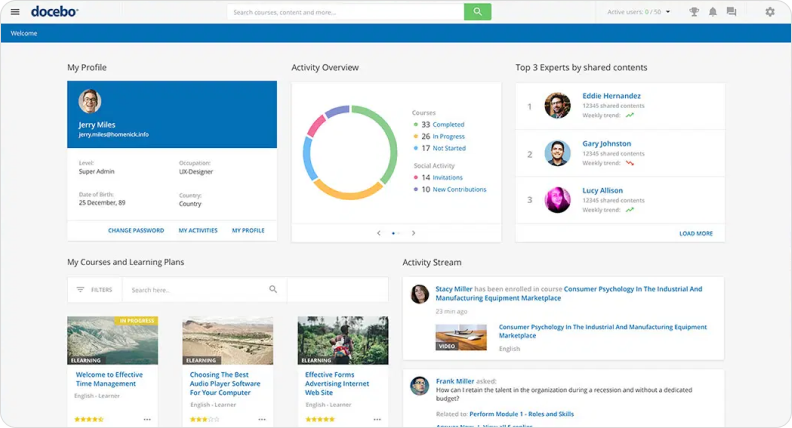
Docebo is built for organizations where the onboarding process serves several audiences at once, employees alongside partners and customers, from a single digital platform.
AI that earns its keep at scale
Personalization is the real differentiator. Docebo uses AI to suggest content, manage training catalogues at scale and build personalized learning experiences that adapt as new employees move through the first year. With hundreds of courses and several thousand learners, that pays for itself.
With sixty new hires a year, it does not. At that volume the personalized learning paths are impressive without being necessary, because the model has too little signal to beat a well built manual track, and the onboarding experience is no better for it.
Integration capabilities are extensive across the HR systems most large employers run, and the analytics are investigative rather than descriptive. If you want to link onboarding completion to new hire productivity, this platform is the most likely to manage it without exports.
Complexity is the trade off
Configuration is a project, not an afternoon. Every Docebo implementation I have seen needed a dedicated owner for a quarter. Pricing is quote based and starts well above the mid market, with figures around $25,000 a year reported for entry configurations.
The mobile app also attracts noticeably weaker ratings than the web platform. G2 puts Docebo at about 4.3 out of 5 across roughly seven hundred and fifty reviews, below the smaller specialists here.
6. Litmos
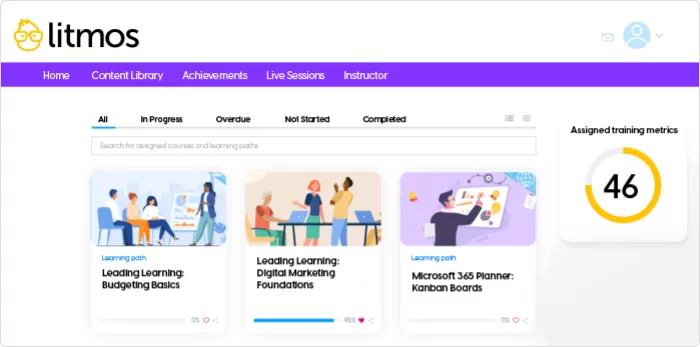
Litmos solves one problem better than anything else here: compliance training live next week with no content team.
A ready made compliance library
The bundled library covers harassment prevention, data protection, workplace safety and the rest of the standard corporate training catalogue, updated by the vendor as regulations change. For a company whose onboarding strategy amounts to a slide deck and good intentions, that is a fast route to a defensible position.
Automated assignments, learning paths and progress tracking all work as advertised, and the Salesforce integration is the deepest of any platform reviewed here. It also removes a common failure mode: teams that build their own training programs from scratch launch late, and new hires end up in classroom training sessions that were meant to be online.
Where the price stops making sense
Costs have climbed since the product left SAP’s direct orbit, and pricing is quote based. Permission management across teams is needlessly complicated, and I have watched administrators lock themselves out of their own reports.
The independent scores reflect that: roughly 4.3 on G2 across about seven hundred reviews and 4.2 on Capterra, the weakest pair here. Without the content library, the value case thins quickly.
How to integrate LMS and onboarding systems
A platform that does not talk to your HR stack quietly recreates the administrative burden you bought it to remove. Most teams underestimate this part.
What to connect first
Order matters. Connect identity before content. Single sign-on through SAML or OpenID Connect gets people in; automated provisioning through SCIM creates and deactivates new employee accounts as employee data changes in the HR system. Those are two different jobs, and confusing them is the most common mistake I see.
Once accounts flow on their own, map the HR fields that drive assignment: job title, department, location, start date. That is what turns automated learning paths from a demo feature into digital onboarding that runs itself. Employee data quality is the hidden variable here, because inconsistent job titles send new hires the wrong onboarding training on day one.
The standards that matter
For content, SCORM remains the interoperability floor and xAPI captures the richer signals, including offline activity and on the job assessment. LTI 1.3 covers external tools.
Ask any vendor which of these they support natively rather than through a paid connector, and what happens to historical records if you migrate later. Around half of organizations still report difficulty connecting an LMS to older HR systems, so budget integration works honestly. A seamless LMS rollout is mostly a data project in disguise. Teams that expect a seamless LMS deployment with no data work slip a quarter.
Conclusion
The short version: TalentLMS if you need onboarding training live this month on no budget, iSpring LMS if employee onboarding is the first step of a longer development path and you want on the job verification, Absorb if compliance and scale dominate, Docebo for several audiences at once.
The best LMS for onboarding is the one that matches how your onboarding process already works, not the one with the longest feature list.
Two things before signing anything. Map one real onboarding journey end to end, from the offer letter to the ninety day review, and count the manual steps your onboarding programs still require. Then ask each vendor to demonstrate that exact path during the trial, using your roles and training content, rather than their own demo script.
Poor onboarding rarely announces itself. It shows up months later as employee turnover among new hires who never quite understood what the job required, which is why an effective onboarding process is worth the effort even when the bill looks uncomfortable. New employees who start well tend to continue well, and employee training after month one costs far less.
An LMS for employee onboarding and training only pays for itself when it removes manual effort you can name and count. Whichever employee onboarding LMS tool you settle on, buy the onboarding experience you actually run, not the one in the brochure.
FAQ
What are the 5 C’s of employee onboarding?
The framework comes from Talya Bauer’s work for the SHRM Foundation. Her original model set out four C’s: compliance, clarification, culture and connection. A fifth, confidence, came later, and Bauer has since proposed a sixth, checkback, covering the follow up conversations most organizations skip.
Sources disagree on the fifth C, with some listing check back in place of confidence, so cite whichever version you use carefully. The underlying research is solid: the 2007 meta analysis in the Journal of Applied Psychology remains the reference point, and Bauer and colleagues published an updated review in the Journal of Management in 2025.
What are the top 5 LMS systems?
Any ranking depends on its criteria, so treat every list of this kind as an argument rather than a fact. Judged on onboarding, using the five criteria set out earlier, my top five are TalentLMS, iSpring LMS, 360Learning, Absorb LMS and Docebo, with Litmos sixth on its compliance library alone.
A general purpose ranking would come out differently, because a top-rated LMS for onboarding new employees is not automatically the right choice for customer education, partner enablement or general employee training.
What is LMS onboarding?
LMS onboarding means running your induction through a learning management system rather than through documents, email and hallway conversations. New hires never have to ask where to start. New employees are enrolled automatically based on their role, work through structured onboarding courses at their own pace, and all their onboarding training is recorded in one place, alongside the company values and company culture they need to absorb.
Done properly, an LMS for employee onboarding and training replaces the traditional onboarding methods that quietly cost the most: the repeated verbal briefing, the untracked policy sign off, the compliance form nobody can locate in April. Poor onboarding is rarely a content problem. Choosing the right employee onboarding LMS tool is less about features than about deciding which parts of the employee onboarding process you want to stop doing by hand.




David,
We are looking for help with fitting a Scorm 1.2 program with Petrofac SkillsVX LMS.
If you could help or recommend any reliable person, that would be very helpful.
Please reply to my email address.
Thanks,
Dan
thankyou
thanks
thank you