
Search for the best LMS providers in the UK and you will find plenty of lists, most of them quietly crowning whoever wrote the page. This one is built to be useful instead. A learning management system is a long commitment, usually three to five years, and no platform is best for every organisation, so the real question is which one fits your size and sector and keeps your data where it needs to be. Below I compare the British-built vendors alongside the global systems used here, so you can turn a long list into a short one.
I have spent years choosing and rolling out learning platforms for UK teams, and I have written this the way I would brief a client. You get twenty learning management systems, grouped into UK vendors and the international names popular here, each with a plain read on who it suits, what it does well, what to watch, and how it charges.
TL;DR: the shortlist at a glance
Short on time? Here is the quick version.
For a fast, low-cost start, TalentLMS is hard to beat. For UK regulatory compliance, Skillcast and Kallidus are the names that come up most. If most of your training already lives in PowerPoint, iSpring LMS fits that workflow. Prefer open-source control and have IT support? Moodle gives you the most freedom.
For enterprise learning with AI and mixed audiences, Docebo, Cornerstone, and 360Learning are the usual shortlist. And if you need to train customers and partners across separate branded portals, LearnUpon is built for exactly that. The rest of this guide explains the why behind each pick.
How I chose these platforms

I did not rank these by feature count. A long feature list rarely survives contact with a real rollout. Instead I judged each platform against five things that still matter in year three.
- UK or EU data residency. Where does the personal data of your staff actually live? For UK buyers under UK GDPR, storage in a UK or EU region (and a signed DPA) keeps procurement simple. I flag this for every platform below, and it has its own column in the table.
- Transparent pricing. Can you understand the quote and model it against your own numbers? Hidden per-user maths is a common trap, so I note the pricing model for each vendor.
- Ease of adoption. A tool that a non-technical admin cannot run will stall. Adoption beats features, every time, so I weight how usable each platform is for ordinary admins and learners.
- Compliance evidencing. Can you prove that mandatory training happened when an auditor or inspector asks? Certificates, expiry tracking, and audit-ready reporting count here, not just course delivery.
- Integration. Does it connect to Microsoft 365, your HRIS, and single sign-on without a project of its own? I treat this as a selection criterion, not an afterthought.
A quick word on pricing

Most UK vendors quote in one of two ways. Per seat (also called per registered user) charges for everyone you add, whether or not they log in. Per active user charges only for the people who actually use the platform in a given month. The difference is large. If you register 500 staff but only 120 log in each month, a per-active-user model can cost a fraction of a per-seat one. Always ask how a “user” is counted before you compare two quotes.
Then look past the licence. Cloud LMS list prices in the UK tend to run from around £2 to £15 per user per month, and enterprise platforms often start in the tens of thousands a year. The subscription is rarely the whole bill. Set-up, implementation, data migration, SSO configuration, and content can all be billed as a project, and higher support tiers cost extra. Open-source Moodle shows the same point in reverse: the software is free, but hosting, upgrades, and admin time are not. When you compare vendors, compare total cost of ownership over three years, not the headline monthly rate.
UK learning management systems compared at a glance
Here is the whole field in one view. Data residency notes reflect published vendor information as of August 2026, so confirm the exact region and DPA with any vendor during procurement.
| Platform | Best for | UK / EU data residency | Pricing model | Ready-made content library | Best-fit size |
| THRIVE | Learner-led social learning and skills | UK vendor, UK GDPR (confirm region) | Quote-based | Yes, Content Club | Mid-market to enterprise |
| Growth Engineering | Gamified engagement and behaviour change | UK vendor, UK GDPR | Quote-based | No, bring your own | Mid-market |
| Kallidus | Blended learning with compliance reporting | UK vendor, UK GDPR | Quote-based | Yes, add-on library | Mid-market to enterprise |
| Skillcast | UK regulatory compliance training | UK vendor, ISO 27001 | Per user, per year (tiered) | Yes, UK compliance courses | SME to enterprise, regulated |
| Ciphr | HR and L&D in a single system | UK vendor, UK GDPR | Quote-based | Yes, vendor library | Mid-market |
| Open eLMS | Accessibility and configuration | UK vendor | Quote-based | Yes, plus authoring | SME to enterprise, education |
| Synap | Exam and assessment delivery | UK vendor | Tiered, quote for scale | No, assessment-led | Professional bodies, education |
| Access Learning | Compliance plus content library | UK vendor | Quote-based | Yes, large UK library | SME to mid-market |
| Confirm (formerly Learning Pool) | Learning joined to compliance and performance data | UK vendor (Derry), SOC 2, Cyber Essentials | Quote-based | Yes, extensive off-the-shelf | Mid-market to enterprise |
| Learn Amp | Learning joined to engagement and performance | UK vendor (London), confirm region | Tiered by organisation size, annual | Yes, curated plus integrations | Scale-ups to enterprise |
| iSpring LMS | PowerPoint authoring and simple admin | EU (AWS Dublin and Frankfurt), DPA and SCCs | Per active user | Yes, optional library | SME to mid-market |
| TalentLMS | A fast, cheap first LMS | US/AWS by default (ask about EU) | Per active user (published tiers) | Yes, TalentLibrary | SME |
| Docebo | Enterprise AI and extended enterprise | EU hosting available | Per active user, quote-based | Yes, Docebo Content | Mid-market to enterprise |
| Absorb | Clean admin and quick launch | Multi-region incl. EU (confirm) | Per active learner, quote-based | Yes, Absorb Amplify | Mid-market to enterprise |
| 360Learning | Collaborative, peer-built learning | EU (French vendor), GDPR | Registered or active user | Partial, marketplace | Mid-market to enterprise |
| LearnUpon | Extended enterprise, multi-portal | EU by default (Irish vendor), configurable | Quote-based, higher entry | Partial, via partners | Mid-market to enterprise |
| Moodle | Open-source control, low licence cost | Self-hosted or UK partner (full control) | Free core; hosting or MoodleCloud tiers | No, community plugins only | Any, with IT resource |
| Cornerstone | Enterprise learning plus talent and skills | Regional hosting options | Per user, quote-based | Yes, Content Anytime | Enterprise |
| Canvas (Instructure) | Education and structured courses | Regional hosting options | Quote-based | No, academic content | Schools, universities, providers |
| Totara | Public sector and regulated compliance at scale | Self-host, UK partner or Totara Cloud; ISO 27001, Cyber Essentials, NHS DSPT | Quote-based via partner | No, partner and third-party libraries | Large, complex, regulated |
UK-built learning management systems
I am leading with the British vendors, because a UK-built platform often makes the data-residency and support questions easier to answer.
1. THRIVE
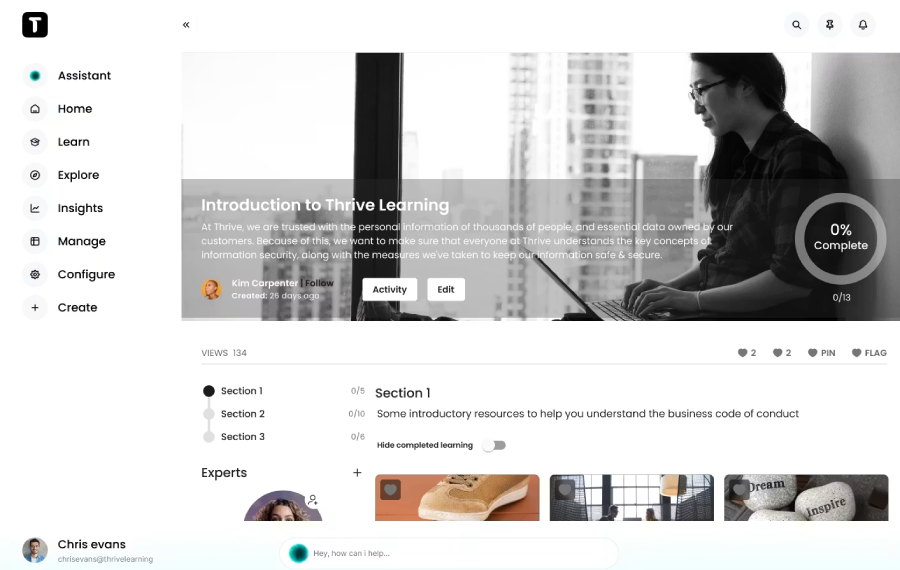
THRIVE describes itself as “the complete learning and skills platform,” and it blends a traditional LMS with LXP-style, learner-led content and a skills layer. Its Content Club library gives you ready-made material, and the social feed drives engagement rather than plain course assignment. Pricing is quote-based and aimed at organisations that want more than a compliance box-ticker.
Best for: teams that want social, learner-driven development plus skills tracking. My verdict: a strong pick when engagement and skills matter as much as completions.
2. Growth Engineering
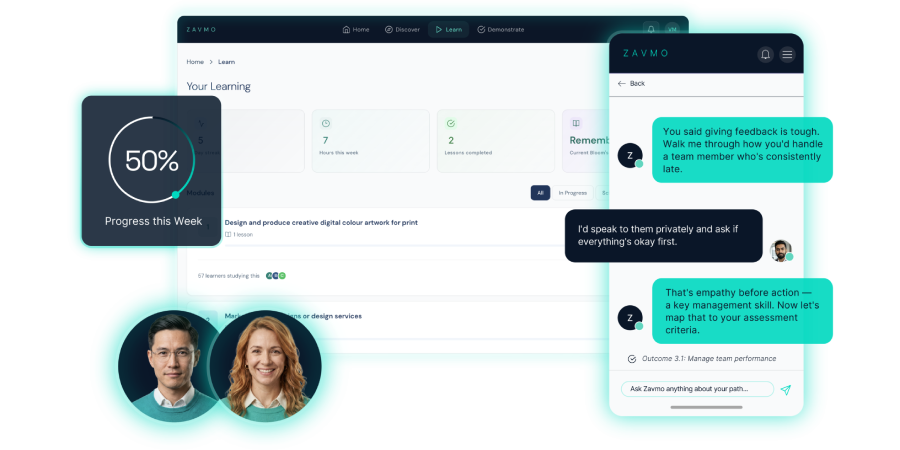
Growth Engineering built its reputation on gamification and behaviour change, and it still leans into that with badges, streaks, and social features. The platform covers the core admin, reporting, and content needs, and it pairs well with organisations trying to lift low learner engagement. Expect a quote based on your user numbers.
Best for: cultures where adoption is the problem and gamified nudges will help. My verdict: effective if engagement is your bottleneck, less essential if it is not.
3. Kallidus
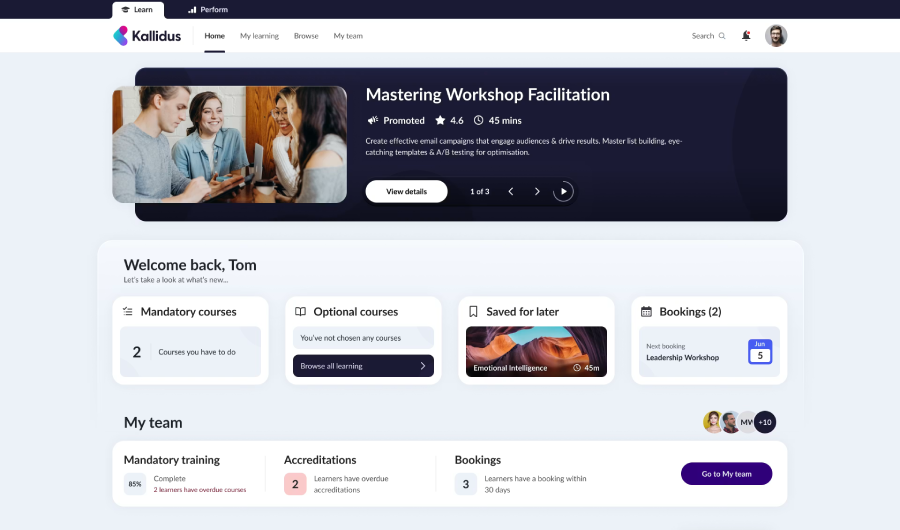
Kallidus, based in Cirencester and a certified B Corp, offers Kallidus Learn alongside performance and recruitment tools. It handles blended learning well, tracks certifications, and produces the kind of reporting that compliance-driven UK organisations lean on. The vendor frames its pitch around escaping “the activity trap,” meaning it wants you measuring impact, not just course completions. Independent listings put entry pricing in the five-figure annual range, so it suits mid-market and up.
Best for: UK firms that need blended learning and audit-ready compliance records.
My verdict: a safe, well-supported choice for regulated mid-market teams.
4. Skillcast
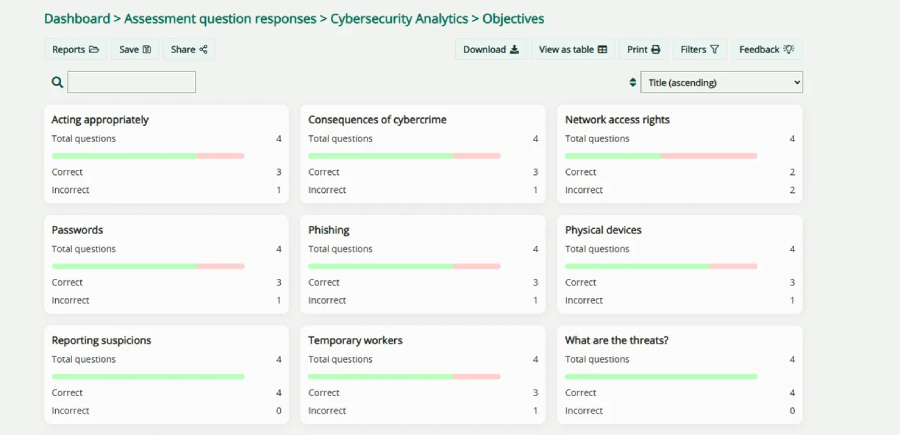
Skillcast is a London compliance specialist with more than two decades behind it, and it is purpose-built for UK regulatory training. Its library covers AML, FCA rules, GDPR, health and safety, and more, much of it CPD-accredited. Higher tiers add compliance registers, policy sign-offs, and declarations, so the platform doubles as a compliance hub. It is ISO 27001 certified, and pricing runs per user per year across tiered plans (third-party listings show an entry tier from a few hundred pounds up to custom enterprise pricing).
Best for: financial services, insurance, and other regulated sectors that need ready compliance courses.
My verdict: the clearest fit on this list for UK compliance evidencing.
5. Ciphr
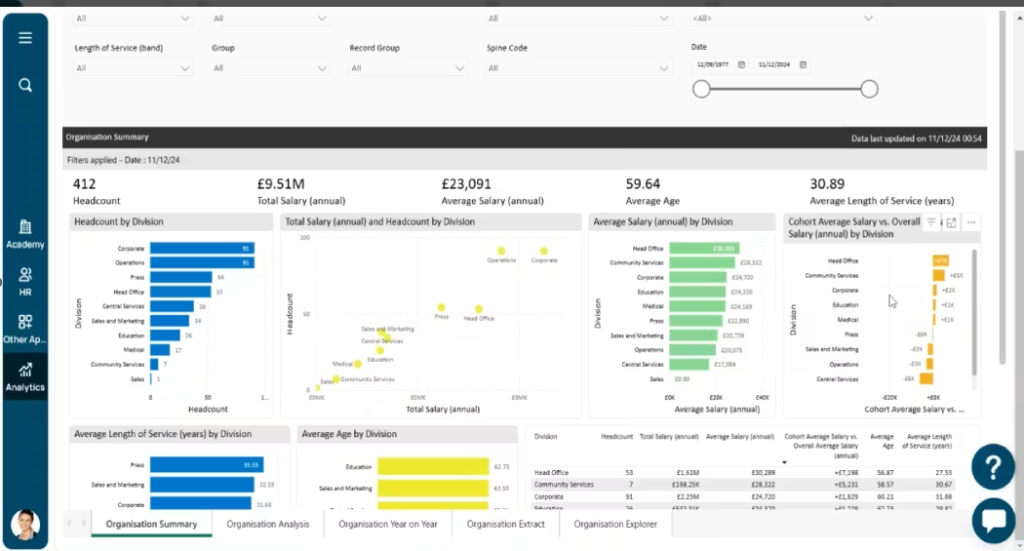
Ciphr brings HR, payroll, recruitment, and learning under one roof, and Ciphr LMS is the learning piece of that suite. It delivers and tracks online training, supports SCORM content, and connects tightly to Ciphr’s HR software so records flow between systems. As a standalone LMS it is fairly conventional, but the integration story is the draw.
Best for: organisations that want their learning management system and HR data in one connected system.
My verdict: most compelling if you already use, or plan to use, Ciphr HR.
6. Open eLMS
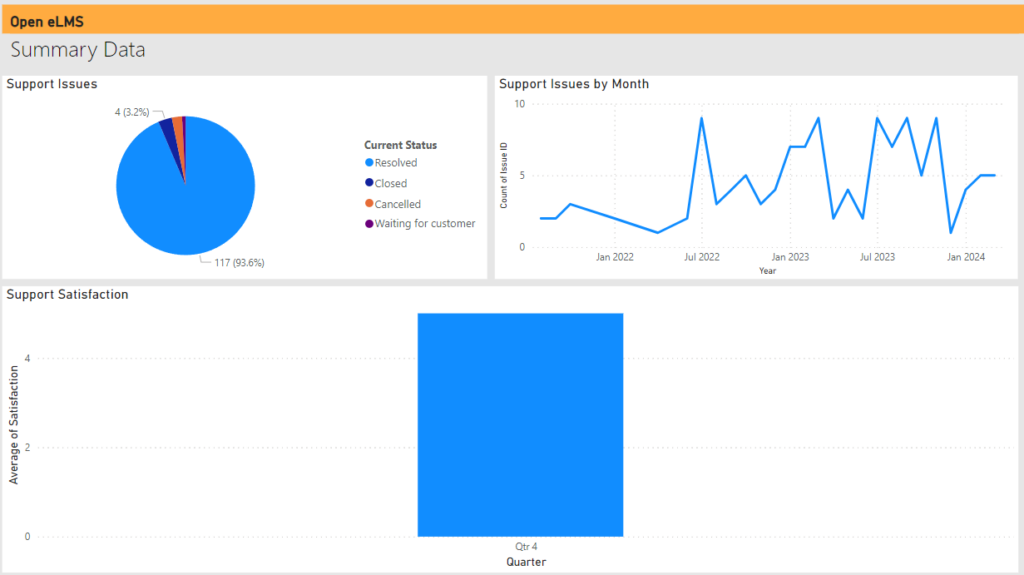
Open eLMS positions itself as a one-stop system for delivery and course creation, with a large set of configuration options. Its standout is accessibility: the platform meets WCAG 2.1 AA, so it works for learners regardless of disability. It serves both business and education, which makes it flexible for mixed use cases. Pricing is quote-based.
Best for: organisations where accessibility and configurability are priorities.
My verdict: a solid, inclusive option, especially where WCAG conformance is a hard requirement.
7. Synap
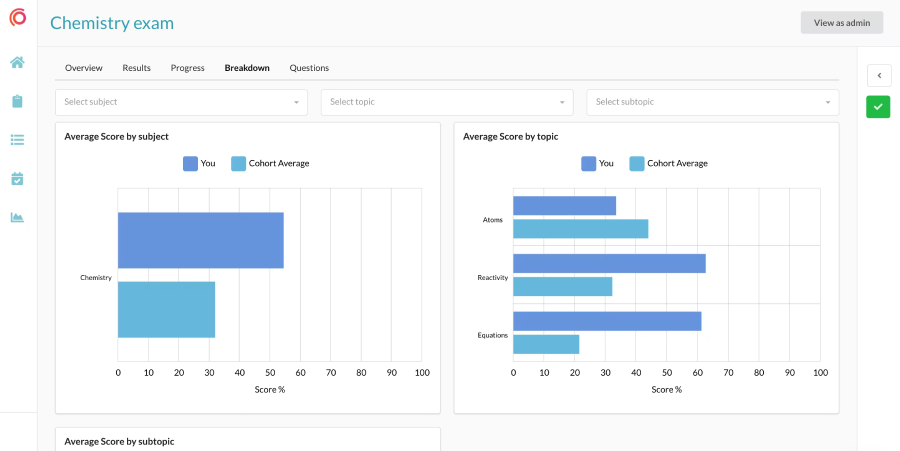
Synap is unusual because it focuses on assessment as much as content delivery. You can build exams with varied question types, set time limits, randomise questions, and run concurrent sittings at scale. That makes it a natural fit for professional bodies, membership organisations, and any team where testing and certification are central. It scales across sectors from education to healthcare and law.
Best for: exam-heavy training and certification programmes.
My verdict: the pick when assessment, not just course completion, is the point.
8. Access Learning
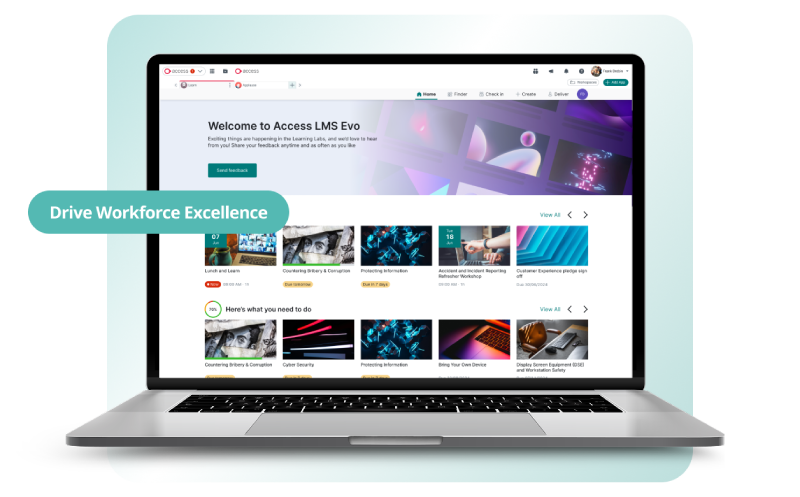
Access Learning is the learning arm of The Access Group, a large UK provider of business software. The LMS pairs an easy admin experience with a course library and mobile app, and it fits organisations already using other Access products. Reporting and compliance management are solid out of the box. Pricing is quote-based.
Best for: SMEs and mid-market teams wanting compliance plus ready content in one place.
My verdict: a dependable all-rounder, strongest inside the wider Access ecosystem.
9. Confirm (formerly Learning Pool)
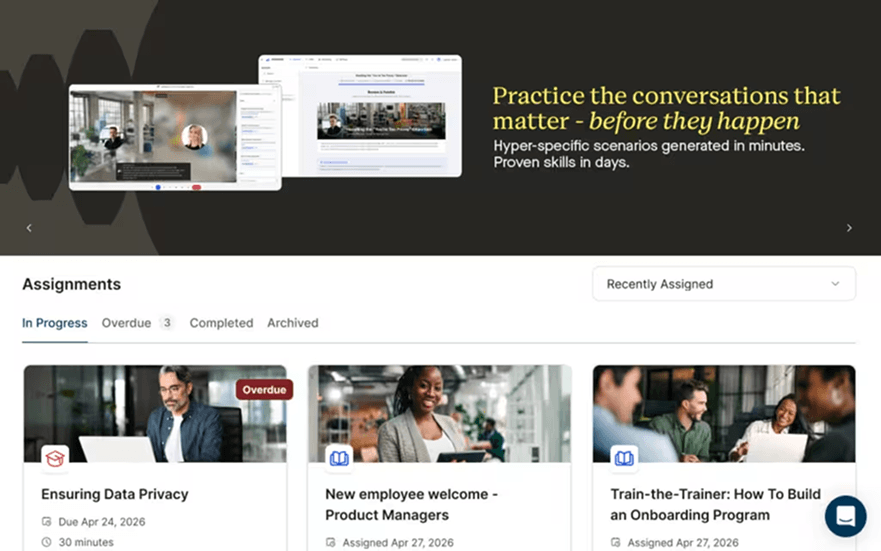
This one needs a note before anything else. On 10 August 2026, Learning Pool rebranded as Confirm. If you have been researching UK vendors for more than a few weeks, the shortlist you built has the old name on it. The company has been building learning technology from Derry since 2006 and employs more than 425 people across the UK and North America. Public sector work built the reputation, and its off-the-shelf compliance content library remains one of the deepest available to UK buyers. What changed alongside the name is the product framing. Confirm has launched what it calls a Workforce Enablement System, pulling learning, engagement, performance and compliance into one platform rather than four. It holds SOC 2 and Cyber Essentials certification. Pricing is quote-based.
Best for: UK organisations that want a large compliance content library alongside the platform, and are interested in joining learning data to performance data.
My verdict: strong on content depth and UK credentials. Go in with specific questions about which parts of the new suite are live, because the rebrand is days old and the integration story is newer than the marketing suggests.
10. Learn Amp
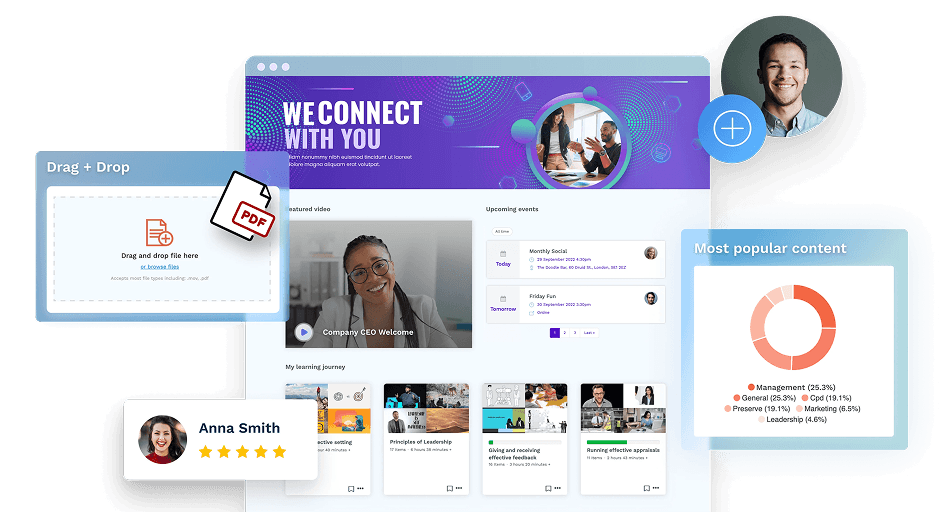
Learn Amp is a London company, founded in 2013. The pitch is a people development platform, which in practice means learning, employee engagement and performance management running in one system rather than three. The learning side was designed as an LMS and an LXP together, so you get structured compliance assignment alongside curated, learner-chosen content and social features. Customers include Metro Bank, Specsavers and Gail’s Bakery, which gives you a fair read on the profile: scaling UK businesses rather than SMEs or global enterprises. Pricing scales with organisation size across tiers, billed annually above the entry plan, and is quote-based in practice.
Best for: scaling UK businesses that want learning, engagement and performance in a single system.
My verdict: a genuinely different proposition to a pure learning management system, and worth shortlisting if you are trying to retire two other tools at the same time.
Global learning management systems used in the UK
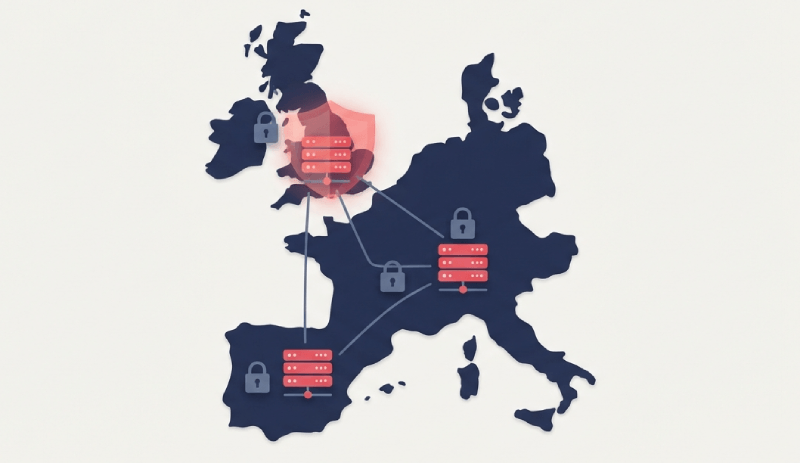
These international systems have large UK footprints. Several offer EU or UK data hosting, which is the first thing I check for any UK buyer.
11. iSpring LMS
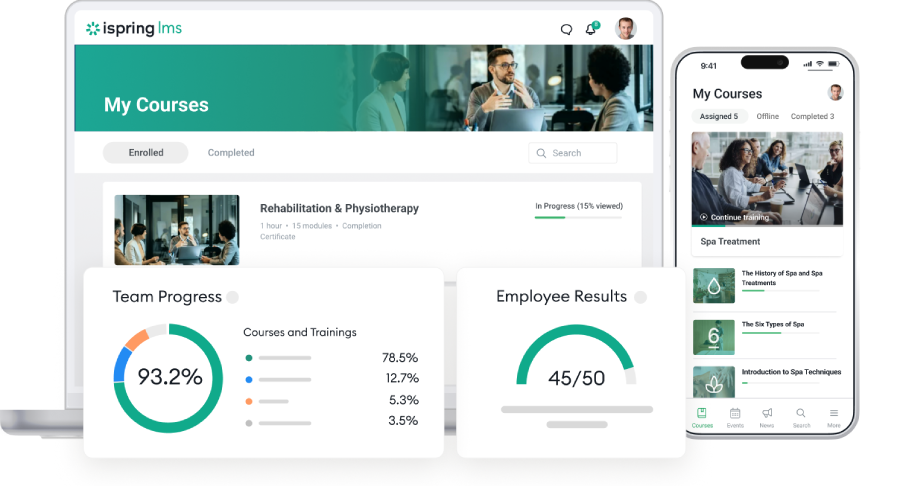
iSpring LMS pairs a straightforward learning platform with the iSpring Suite authoring toolkit, so teams that build training in PowerPoint can turn slides into tracked courses quickly. The admin side is clean, with automation for enrolment, certificate issuance, and report delivery, plus programmable reports, a built-in knowledge base, on-the-job training, and a mobile app for blended learning. For UK and EU customers, data is stored in Europe, on AWS in Dublin and Frankfurt, with a DPA and standard contractual clauses. AI course generation and ElevenLabs text-to-speech are available through iSpring Cloud AI alongside the learning management system. It runs on a per-active-user model, so you invite everyone and pay for those who log in each month. You can read my full iSpring LMS review for the detail.
Best for: medium-sized enterprises that author a lot of their own content in PowerPoint and want EU data residency.
My verdict: an easy platform to run, with a clear, published residency answer; model the per-active-user cost against your real login rate.
12. TalentLMS
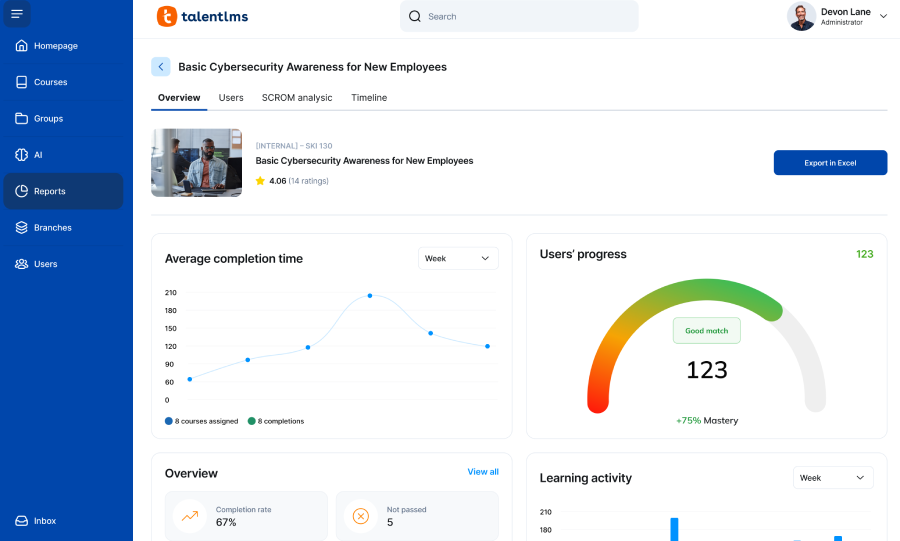
TalentLMS, from Epignosis, is the platform I most often suggest for a first LMS. It is quick to set up, affordable, and usable without a technical team. You get SCORM and xAPI support, gamification, and TalentLibrary, a set of ready-made courses that shortens time to launch. Published tiers make budgeting easy, and it charges per active user. Data sits on AWS by default, so confirm any UK or EU residency options with the vendor if that is a hard requirement. My full TalentLMS review goes deeper.
Best for: small teams that want to launch fast on a tight budget.
My verdict: the pragmatic starter learning management system, provided residency is not a blocker.
13. Docebo
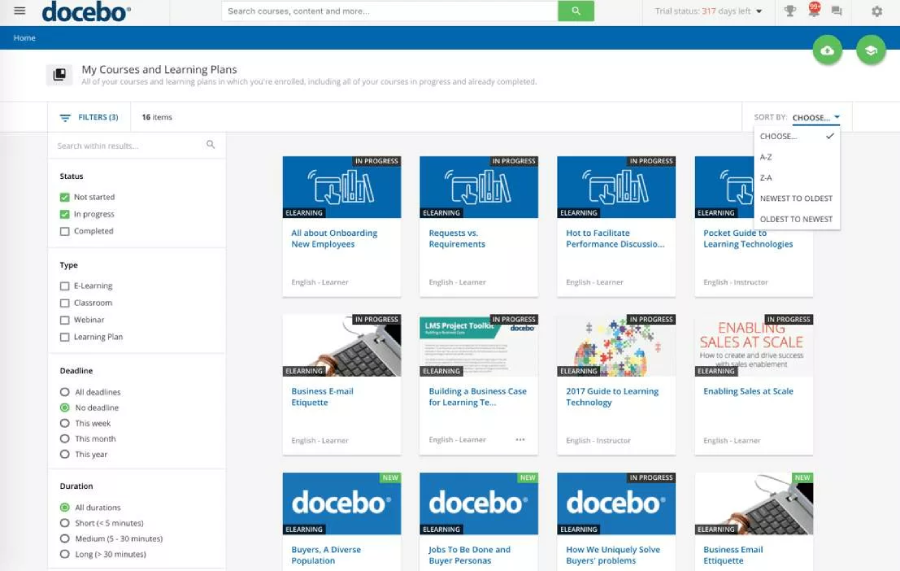
Docebo is an enterprise platform built around AI, automation, and extended enterprise use, meaning you can train employees, partners, and customers from one system with separate branded portals. It supports SCORM, xAPI, and AICC, over 40 languages, and deep integrations. EU hosting is available through the vendor and its partners. Pricing is per active user and quote-based, and it sits at the premium end (industry benchmarks commonly start around the mid five figures a year). See my Docebo review for a closer look.
Best for: mid-market and enterprise teams that need AI features and multi-audience training.
My verdict: powerful and scalable, but priced and sized for larger buyers.
14. Absorb
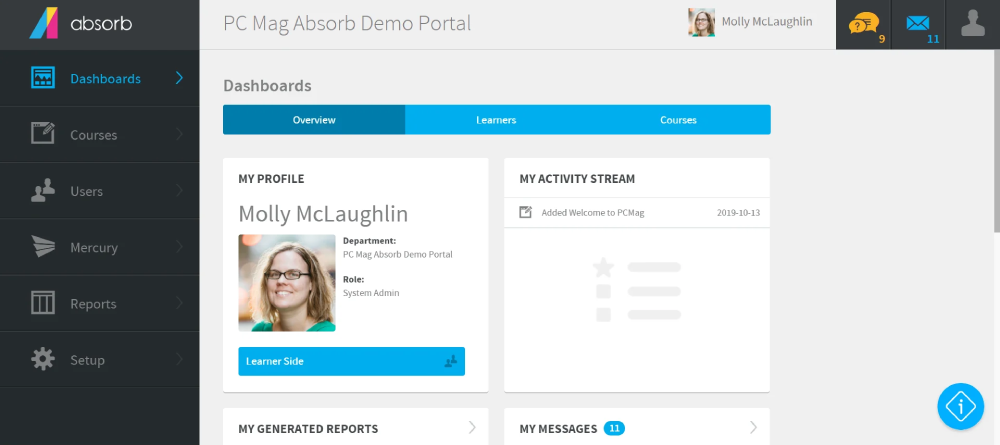
Absorb is known for a clean interface, fast implementation, and strong out-of-the-box reporting. It suits mid-sized organisations that want to train employees at scale without customising every screen. Multi-portal, e-commerce, and advanced analytics sit in higher tiers or add-ons. Hosting is available in multiple regions including the EU, so confirm your region during procurement. Pricing is per active learner and quote-based, in the mid-to-premium bracket.
Best for: mid-market teams that value ease of use and quick rollout.
My verdict: a polished, low-friction platform for internal training at scale.
15. 360Learning
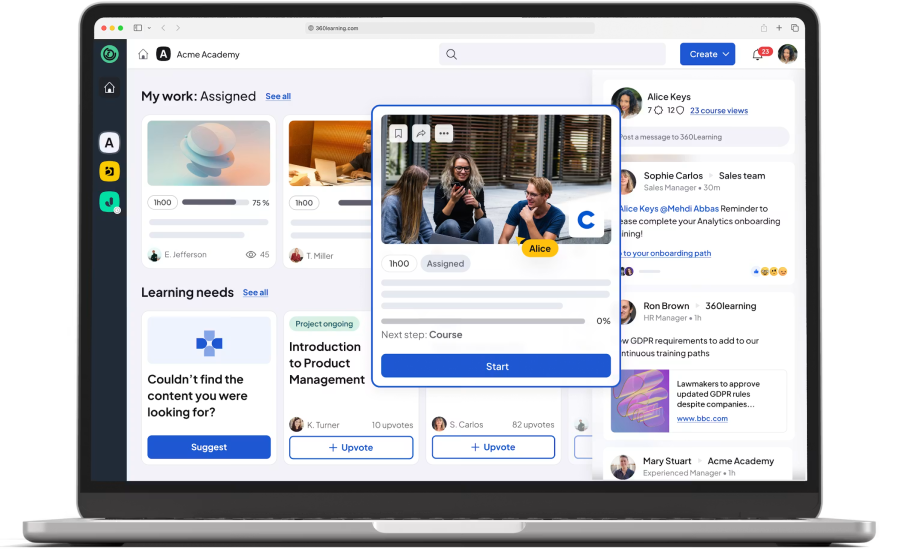
360Learning, a French vendor, is built around collaborative learning: subject-matter experts co-create courses, and learners discuss, upvote, and contribute. That peer-led model helps organisations capture internal knowledge fast. Data sits in the EU and the platform complies with GDPR. Pricing is flexible, with registered-user, monthly-active-user, or mixed models in a single contract, plus a 30-day trial.
Best for: teams that want experts and learners building content together.
My verdict: a genuinely different approach, strongest where tribal knowledge lives in your people.
16. LearnUpon
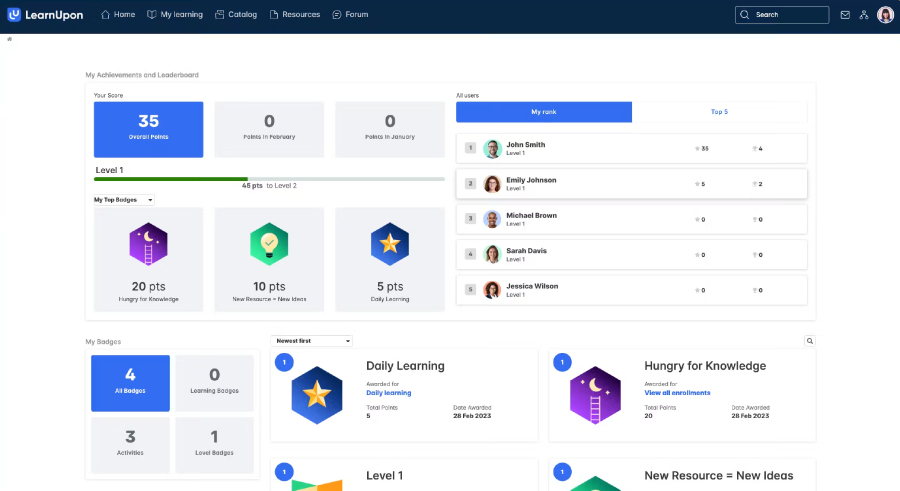
LearnUpon is a Dublin-founded platform built for extended enterprise, so it shines when you train customers, partners, and members alongside staff, each in their own portal. Its multi-portal architecture keeps audiences cleanly separated, and it integrates well with Salesforce. As an Irish company it hosts EU data by default, with SOC 2 Type II certification and a GDPR DPA, and data-residency options in other regions on request. Pricing is quote-based with a higher entry point, so it fits mid-market and up.
Best for: organisations training external audiences across multiple branded portals.
My verdict: a strong EU-hosted option for extended-enterprise use, less suited to a tiny internal-only team.
17. Moodle
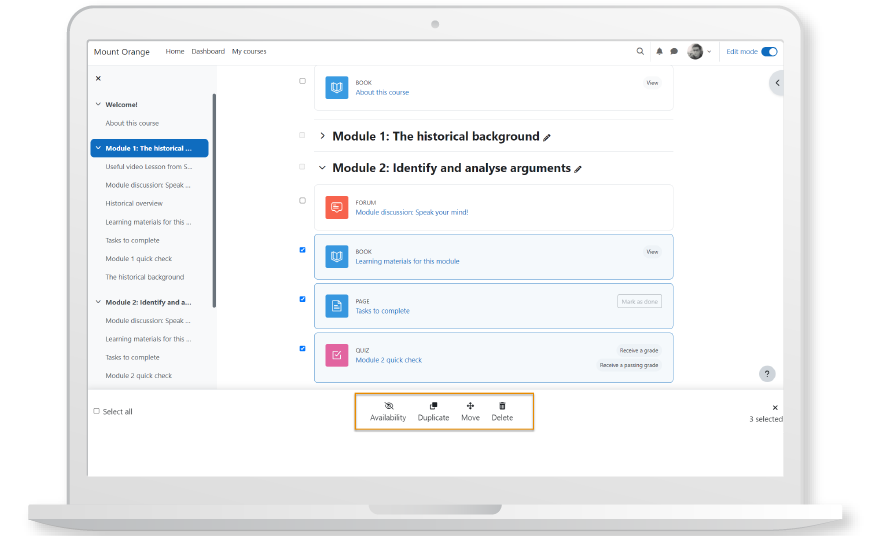
Moodle is the world’s most-used open-source learning management system, and its core software is free. You can self-host on your own UK infrastructure, use a UK Certified Partner, or run MoodleCloud, whose plans start low for small teams. Self-hosting or a partner gives you full control over where data sits, which is a real residency advantage. The trade-off is effort: Moodle needs setup, maintenance, and either a sysadmin or a partner, and the default interface feels dated. My Moodle review covers the practicalities, and it appears in my roundup of free LMS options too.
Best for: teams with IT resource that want control and a low licence cost.
My verdict: unbeatable on flexibility and price if you have the technical support to run it.
18. Cornerstone
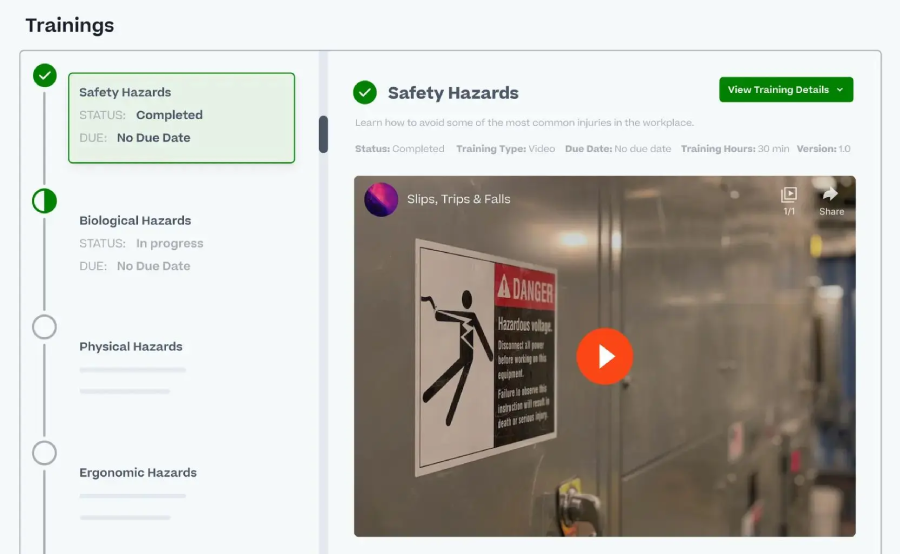
Cornerstone is an enterprise system that ties learning to performance, skills, and broader HR. It suits large organisations that treat training as part of a wider talent strategy, with automation, multilingual support, and audit trails built in. Regional hosting options are available for data residency. Pricing is per user and quote-based, and it sits firmly at the enterprise end.
Best for: large enterprises aligning learning with talent and skills management.
My verdict: comprehensive for big organisations, heavier than most SMEs need.
19. Canvas (Instructure)
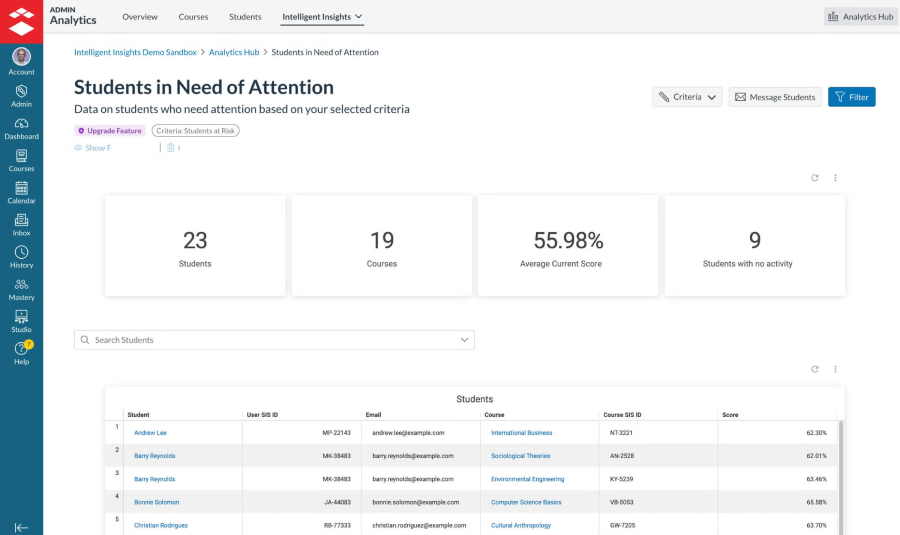
Canvas, from Instructure, is best known in education, from schools to universities, though training organisations use it for structured, content-first courses. It offers strong assessment, grading, and collaboration tools, plus a clean learner experience. Regional hosting options support data-residency needs. Pricing is quote-based.
Best for: schools, universities, and providers delivering structured academic-style courses.
My verdict: the natural choice for education, less tailored to corporate compliance.
20. Totara
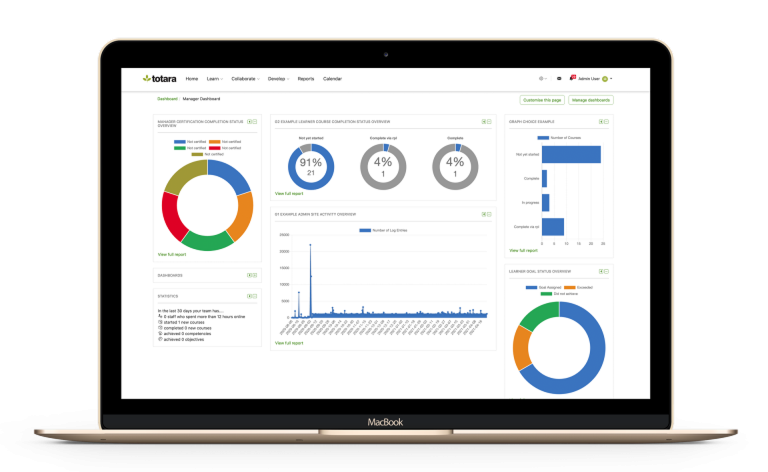
Totara deserves a place on any UK list, because in NHS trusts and government bodies it is close to a default. Technically it started from the Moodle codebase and evolved into an enterprise open-source system, sold and implemented through certified partners rather than direct. You avoid vendor lock-in, you can extend the code, and you choose whether to self-host in the UK, use a partner, or take Totara Cloud. The cost of all that is complexity. Granular permissions and configurable everything mean a new administrator faces a real learning curve, and you will need a partner relationship rather than a support inbox. Pricing comes through the partner and is quote-based.
Best for: NHS trusts, government bodies and other large regulated organisations with layered compliance and recertification requirements.
My verdict: unmatched for UK public sector compliance evidencing, and overkill for anyone without a dedicated administrator or partner budget.
UK e-learning companies or a global platform?

A lot of readers arrive here searching for “e-learning companies UK” or an “e-learning provider” in London, then realise they are really choosing between two camps. The trade-offs deserve an honest look, because neither camp is automatically the safer bet.
A UK e-learning company (the British-built vendors above, plus specialists like Skillcast and Kallidus) tends to make three things easier. Data residency is usually a short conversation, since the data already sits in the UK or EU. Support runs in your time zone, often with people who know UK regulation. And compliance content is written for FCA, HMRC, and UK GDPR rather than adapted from a US template.
The global platforms answer a different need. They typically bring deeper features, more mature AI, wider integrations, and the scale to run tens of thousands of learners across regions. Several, including iSpring LMS, Docebo, 360Learning, and LearnUpon, host data in the EU, so the residency gap is smaller than it once was. What you weigh is roadmap and depth against local fit and simplicity.
My rule of thumb: if compliance evidencing and UK support are your top priorities, start with a UK vendor. If scale, AI, or extended-enterprise training lead your list, a global platform earns its place. Shortlist one or two from each camp and let the trial decide.
One distinction worth making before you go further. Everything on this page is a platform: software that delivers training and tracks who completed it. An e-learning company is something else, a supplier that builds the courses themselves. If your problem is that nobody finishes the training you already have, an agency will help you more than a new platform will. If your problem is that you cannot prove who completed what, you are in the right place.
How to choose the right LMS for your UK business
Match your situation to the strongest-fit options rather than the longest feature list. Here is how I map common UK scenarios.
| Your situation | Where I would look first | Why |
| 10 to 50 staff, tight budget | TalentLMS, MoodleCloud, iSpring LMS | Low entry cost, quick to launch, no big project needed |
| Regulated sector needing ready compliance courses | Skillcast, Kallidus, Access Learning | Prebuilt UK compliance libraries and audit-ready reporting |
| Lots of existing PowerPoint content | iSpring LMS | Slide-to-course authoring is native to the workflow |
| Training customers or partners | LearnUpon, Docebo, 360Learning | Multi-portal and extended-enterprise features |
| Full control and data sovereignty | Moodle (self-hosted or UK partner) | You decide where data sits and how it is configured |
| Enterprise learning plus talent and skills | Cornerstone, THRIVE, Docebo | Skills, performance, and AI at organisational scale |
| Schools or universities | Canvas, Open eLMS | Built for academic delivery and assessment |
UK sector requirements: what actually gets asked in an audit
Generic feature lists fall apart the moment a regulator, inspector or auditor asks for evidence. What they want is rarely “does the platform have reporting”. It is “show me that this named person completed this named course before this date, and show me it has not expired”. Here is what that looks like sector by sector.
Healthcare and social care. CQC inspections turn on evidence of mandatory training, and NHS organisations work to the Core Skills Training Framework, which makes ESR integration and CSTF record handling the deciding factors. I go through this properly in my guide to choosing an LMS for healthcare.
Financial services. The FCA expects competence to be demonstrated rather than asserted, and the Senior Managers and Certification Regime pushes that down to named individuals, so attestation workflows and audit trails matter more than course libraries. My guide to LMS for banking and financial services covers the detail.
Public sector generally. Procurement usually runs through G-Cloud or a framework, which narrows the field before you start. Expect Cyber Essentials Plus as a minimum, often ISO 27001, and accessibility conformance to WCAG 2.2 AA under the Public Sector Bodies Accessibility Regulations. Ask for the vendor’s accessibility statement and a VPAT before you shortlist, not after.
Every sector. Under UK GDPR you need to know where staff personal data is stored, hold a signed DPA, and understand the transfer mechanism if data leaves the UK. That question belongs in your first vendor conversation, not your procurement paperwork.
Common mistakes UK learning management system buyers make
A few errors come up again and again. Avoiding them will save you money and a painful migration later.
- Paying per registered user for dormant seats. If half your workforce logs in rarely, a per-seat licence bleeds budget. Check whether the vendor offers per-active-user billing before you sign.
- Buying a course-selling tool for internal training. Platforms tuned for selling courses to the public are not always the best fit for staff compliance and onboarding. Match the tool to the job.
- Treating integration as an afterthought. If the learning management system will not talk to Microsoft 365, your HRIS, or SSO, admins end up managing users by hand. Confirm the integrations you need up front.
- Skipping the data question. Ask where personal data is stored, request the DPA, and confirm the region. UK GDPR makes this a procurement issue, not a nice-to-have.
- Choosing on feature count. The platform with the most features is rarely the one your team adopts. Weigh usability and support as heavily as capability.
How to trial a learning management system before you buy

A sales demo shows you the vendor’s best angle. A hands-on trial shows you the truth. When I test a platform, I run the same short checklist every time.
Assign a real course to a small pilot group. Complete it yourself on a phone, not just a laptop, to see how the mobile experience holds up. Then pull an audit-ready report and check whether it gives you certificate and expiry data an inspector would accept. Add a couple of users through your SSO or HRIS to test the integration. Finally, ask your least technical colleague to run an admin task unaided. If they manage it, adoption will follow.
If you are sizing this up for a smaller team, my guide to the best LMS for small business walks through the same decisions at that scale.
Conclusion
Twenty platforms is a long list, so here is how I would use it. Cut it to three on the two questions that are hardest to change later, which are where your data lives and how you will be charged per user. Then run the trial checklist above on those three, with your least technical colleague doing the admin tasks. Whichever survives that is your answer, and it will not always be the one with the best feature comparison.
If you have used any of these platforms, or think there is a UK vendor missing from this list, leave a comment. I update this page as the market moves, and reader corrections are usually the fastest way I hear about it.
Frequently asked questions
What is the best LMS for a UK business or SME?
There is no universal best. For small UK businesses on a budget, TalentLMS, iSpring LMS, and MoodleCloud are common starting points. For compliance-led sectors, Skillcast or Kallidus tend to fit better. The right answer depends on your size, sector, and data requirements.
Which LMS platforms store data in the UK or EU?
iSpring LMS stores EU and UK data in Europe (AWS in Dublin and Frankfurt). LearnUpon hosts EU data by default as an Irish company, and 360Learning is EU-hosted. Docebo and Absorb offer EU hosting, and Moodle lets you self-host in the UK. Always confirm the specific region and DPA with the vendor.
How much does an LMS cost in the UK?
Cloud learning management system pricing generally runs from around £2 to £15 per user per month, with enterprise platforms starting in the tens of thousands per year. Small-business tools sit at the lower end, often with published tiers. Open-source Moodle has no licence fee, but you pay for hosting, setup, and maintenance.
Which is the best LMS for compliance training in the UK?
Skillcast is built specifically for UK regulatory compliance, with FCA, AML, and GDPR libraries and compliance registers. Kallidus and Access Learning also handle compliance evidencing well. iSpring LMS supports certificate automation and audit-ready reporting if you build your own courses.
Should I choose a UK-based LMS or a global one?
A UK-built vendor can simplify data residency, local support, and sector-specific compliance content. A global platform often brings deeper features, AI, and scale. Neither is inherently safer. Judge each on data location, support, and fit rather than nationality alone.
What is the best free or open-source LMS in the UK?
Moodle is the leading open-source option. The core software is free, and you can host it in the UK for full control. Budget for setup, hosting, and maintenance, since “no licence fee” is not the same as “no cost.”
Which learning management system is easiest for a non-technical team to run?
TalentLMS, iSpring LMS, and Absorb are frequently praised for usability by admins without a technical background. Ease of use drives adoption, so I recommend trialling the admin experience with your least technical colleague before deciding.
Is an LMS priced per user or per active user, and how is a user counted?
Both models exist. Per-seat pricing charges for every registered user. Per-active-user pricing charges only for those who log in during a given period, usually a month. iSpring LMS, TalentLMS, Docebo, and Absorb use active-user models. Ask each vendor how a “user” is defined before comparing quotes.
What is the best learning management system for schools or small business in the UK?
For schools and universities, Canvas and Open eLMS are built for academic delivery. For small businesses, TalentLMS, iSpring LMS, and MoodleCloud give you a quick, affordable start. Match the platform to whether your learners are students or staff.
What is a learning management system, and do UK businesses need one?
A learning management system is software that delivers training, tracks who completed it, and produces the records you need when an auditor asks. UK organisations typically buy one when spreadsheet tracking stops working, usually somewhere between 50 and 200 staff, or earlier in a regulated sector.
Which LMS providers are British companies?
THRIVE, Growth Engineering, Kallidus, Skillcast, Ciphr, Open eLMS, Synap, Access Learning, Confirm (formerly Learning Pool) and Learn Amp are all headquartered in the UK. Of the global platforms, LearnUpon is Irish and 360Learning is French, so both keep data in the EU by default.
What happened to Learning Pool?
Learning Pool rebranded as Confirm on 10 August 2026, alongside the launch of what it calls a Workforce Enablement System. It is the same Derry-based company, with the same public sector heritage and content library, under a new name.
Which LMS platforms come with ready-made courses included?
TalentLMS includes TalentLibrary, Access Learning ships a large UK compliance library, Skillcast provides CPD-accredited regulatory courses, and THRIVE includes its Content Club. Docebo, Cornerstone, Absorb and iSpring LMS offer content libraries as paid add-ons rather than bundled.
Does a learning management system need to be WCAG compliant in the UK?
Public sector bodies must meet accessibility regulations, which reference WCAG 2.2 AA. Private organisations have obligations under the Equality Act 2010 to make reasonable adjustments. Ask any vendor for an accessibility statement and a VPAT before shortlisting.
What should I ask a vendor about UK data residency?
Ask three things: which region the personal data is physically stored in, whether they will sign a UK GDPR compliant DPA, and what the transfer mechanism is if any processing happens outside the UK. Get the answers in writing before procurement, not during it.