
Coaching questions are open questions that hand the thinking back to the person in front of you instead of taking it off them. Three of them cover most conversations you will have this week: What’s the real challenge here for you? What have you already tried? What do you want to do next? Everything below is a variation on those three.
TL;DR: seven coaching questions to start with
- What’s on your mind?
- What’s the real challenge here for you?
- What have you already tried?
- What does good look like here?
- What is getting in the way?
- What do you want to do next?
- What do you need from me?
Ask one. Wait. Ask a follow-up before you offer anything of your own. Most managers ask too many questions in one sitting and answer half of them themselves. Three real questions and one long pause beat a list of twenty.
What makes a question a coaching question
A coaching question has one job. It makes the other person think, rather than making them agree with you.
Four quick tests:
- Open. It cannot be answered with yes or no.
- Curious. You do not already know which answer you want.
- Non-leading. “Have you thought about talking to Sam?” is advice wearing a question mark.
- Non-judgmental. “Why did you do it that way?” lands as criticism no matter how kindly you say it.
That last test is why “what” and “how” beat “why” almost every time. “Why are you behind on this?” puts someone into defense. “What has made this week harder than usual?” gets the same information without the flinch. Avoiding “why” questions is the easiest single change most managers can make.
Then there is the pause. Ask a real question and you get three or four seconds of nothing. Managers fill that gap with a second question or a suggestion. The person had just started thinking and you interrupted them.
This is where coaching skills fall apart more often than anywhere else I have watched. Managers do not fail at silence for lack of patience. They fail because nobody told them what to do while they wait. Count to five. Look at your notes. It gets easier around the fourth attempt.
The 7 coaching questions that work in almost any conversation
These seven cover most 1:1s, check-ins and development conversations. Learn them in order and you have a session structure without needing a model.
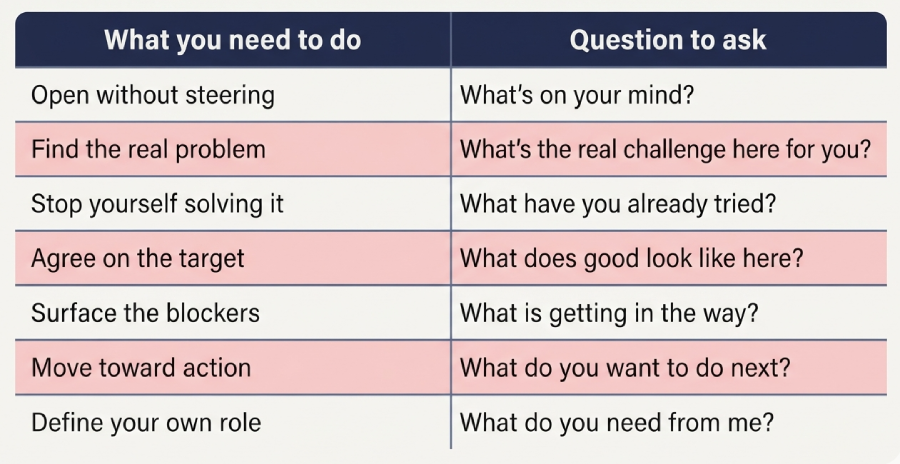
1. What’s on your mind?
An opener with no agenda in it. Giving the other person first choice of topic tells you something before they answer anything else.
2. What’s the real challenge here for you?
Popularized by Michael Bungay Stanier in The Coaching Habit, and the most useful question here. People describe the first problem they thought of, not the one blocking them. The words “for you” stop the conversation drifting into a critique of other departments.
3. What have you already tried?
The ownership question. It surfaces effort you did not know about and stops you suggesting something they abandoned two weeks ago. It also buys you a moment when you can feel yourself about to solve it for them.
4. What does good look like here?
Ask this early in any performance or development conversation. Most disagreements about performance turn out to be disagreements about the standard, found too late.
5. What is getting in the way?
Separates the obstacle from the person. Follow it with “and what else?” at least once. The first blocker named is the socially acceptable one, and the real constraint shows up second or third.
6. What do you want to do next?
The commitment question. Notice the wording: what do you want to do, not what should we do. If the answer is vague, ask for a first step and a date rather than a plan.
7. What do you need from me?
Defines your role without handing the problem back to yourself. Managers who skip it end up owning actions they never agreed to. Be honest when the answer is something you cannot give.
Coaching questions by framework
A framework keeps the session from wandering. It also gives you somewhere to go when your mind blanks. Three are worth knowing, and you only need one of them well.
The GROW coaching model
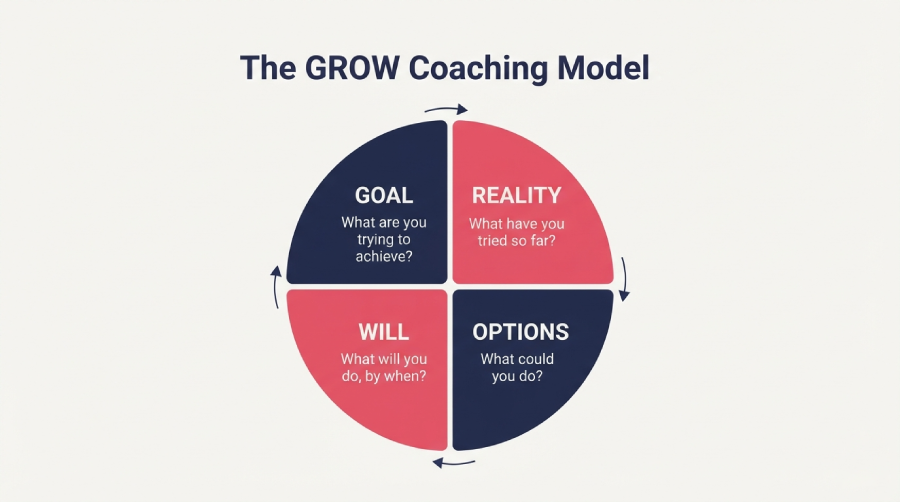
GROW came out of the UK in the 1980s and is associated with Graham Alexander, Alan Fine and Sir John Whitmore, whose book Coaching for Performance put it in front of a wide management audience. It has four stages: Goal, Reality, Options, Will. Most coaching conversations that go badly have skipped one of them, usually Reality.
Goal. What do you want to get out of this conversation? What would make the next thirty minutes worth your time? What are you trying to achieve here, in a sentence? How will you know when you get there?
Reality. What is happening right now? What have you tried so far, and what came of it? Who else is involved? What is in your control here, and what is not?
Options. What could you do? What else? If you had no constraints, what would you try? What would you advise a colleague in this position? Which of these appeals to you most?
Will. What will you do, and by when? What is the first step? On a scale of one to ten, how likely are you to do it? What would move that number up by two? What might stop you?
The scale question in the Will stage earns its place. An answer of six is not a commitment, and asking what would make it an eight is where the real blocker usually shows up.
The CLEAR model
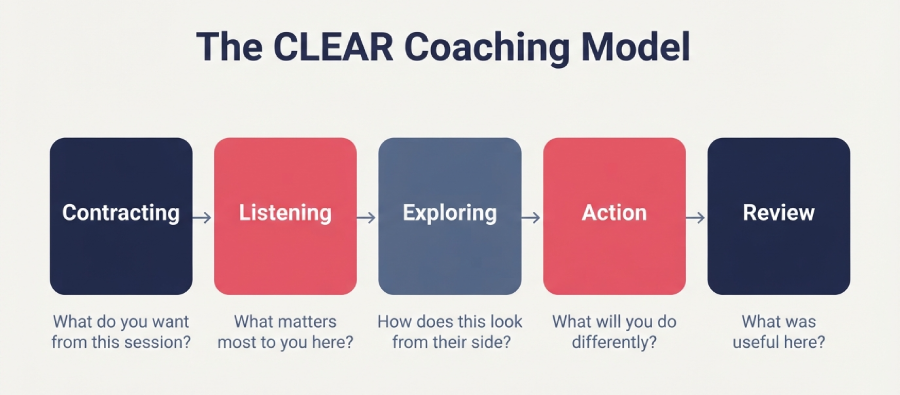
Developed by Peter Hawkins, CLEAR stands for Contracting, Listening, Exploring, Action and Review. It weights the start and end of the conversation more heavily than GROW.
- Contracting. What do you want from this session? How should we work together on it?
- Listening. What is your read on the situation? What matters most to you here?
- Exploring. How does this look from the other person’s side? What would change if you saw it differently?
- Action. What are you going to do differently? What is the smallest version of that?
- Review. What was useful about this conversation? What do you want to pick up next time?
Contracting is the part managers skip. Thirty seconds agreeing what the conversation is for prevents most of the drift.
The OSKAR model
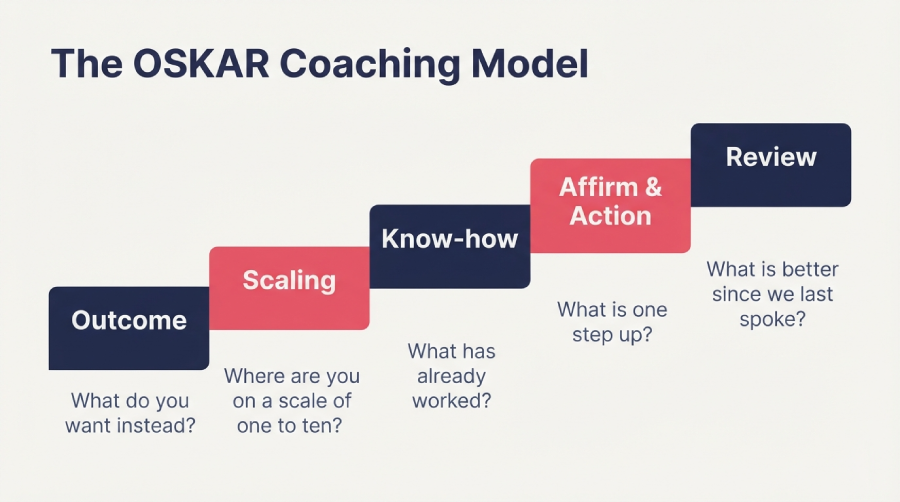
OSKAR comes from solution-focused coaching, set out by Mark McKergow and Paul Z. Jackson in The Solutions Focus. It spends less time on the problem and more on what already works: Outcome, Scaling, Know-how, Affirm and Action, Review.
- Outcome. What do you want instead of this? What would tell you the problem had gone?
- Scaling. On a scale of one to ten, where are you now? What puts you at that number rather than one lower?
- Know-how. What skills have you already used to get this far? Where have you handled something similar?
- Affirm and Action. What is already working that you should keep doing? What is one step up the scale?
- Review. What is better since we last spoke? What did you do that made that happen?
The scaling question is worth stealing even if you use nothing else here.
Coaching questions by situation
One pattern worth knowing before you read these: the questions still in use six weeks after a workshop are the short ones. Anything past ten words gets paraphrased into something clumsier, then dropped. Pick two or three per set and let the rest go.
Someone who is stuck
- What’s the real challenge here for you?
- What have you already tried?
- What would you do if you knew you could not get it wrong?
- What are you assuming that might not be true?
- Who has solved something like this before?
- What is the smallest step that would count as progress?
Someone overwhelmed or burned out
Coach the workload, not the person’s state of mind. If what you hear sounds clinical, stop and point them toward professional support.
- What is taking the most out of you at the moment?
- What would you take off the list if you could take one thing off?
- What does a good week look like right now?
- What have you stopped doing that you used to enjoy at work?
- What would help most in the next seven days?
- What do you need from me that you have not asked for?
Conflict with a colleague
- What is the story you are telling yourself about their intent?
- How might this look from where they are sitting?
- What outcome do you actually want with this person?
- What part of this is yours to fix?
- What have you said to them directly, and what have you only said to others?
- What would a good working relationship look like six weeks from now?
Stepping into a new role
- What does success look like at ninety days?
- Which part of this job are you least sure about?
- What worked in your last role that will not work here?
- Whose trust do you need first?
- What do you want to be known for by the end of the year?
- What are you hoping I will not do?
Underperformance
Coaching questions are for someone who can do the work and is not doing it. If the standard has never been stated plainly, state it first, then coach.
- What’s your own read on how this is going?
- What does good look like here, in your words?
- Where is the gap between that and where you are now?
- What has gotten in the way?
- What would need to change for this to look different in a month?
- What support would make the biggest difference?
Managing change
- What worries you most about this?
- What stays the same, in your view?
- What have you got more control over than it feels like?
- What does your team need to hear from you first?
- What did you learn from the last change you went through?
- What would help you feel ready by the time this lands?
Delivering bad news
Deliver the news first, in plain words. Questions come after, once the person has had a moment.
- What are your first reactions?
- What questions do you have that I have not answered?
- What do you need to know before we talk again?
- What would help in the next few days?
- Who else do you want to hear this from?
- When should we pick this up again?
Career direction
- What work have you done that you would happily do again?
- What are you better at than you were a year ago?
- What would you like to be doing in two years that you cannot do now?
- What is the trade-off you are willing to make for that?
- What experience is missing for that to be possible?
- What is one thing I could put you in front of this quarter?
Someone who feels overlooked
- What made you feel that way? Be specific if you can.
- What recognition would have felt right?
- What work of yours do you think is least visible to me?
- What do you want more of, and what do you want less of?
- What would you want me to do differently?
- What is one thing you would like credit for that you have not had?
How to run the conversation
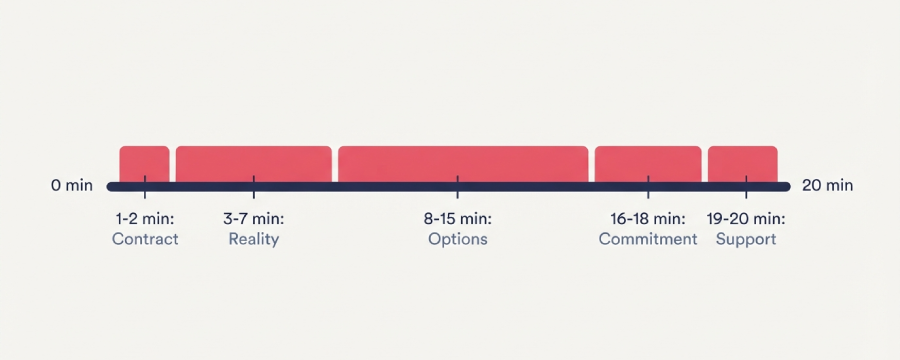
Twenty minutes is enough. Here is a structure that survives a real calendar:
- Minutes 1 to 2. Agree what the conversation is for. This is the coaching contract, and one sentence covers it.
- Minutes 3 to 7. Reality. What is happening, what has been tried.
- Minutes 8 to 15. Options. Their ideas before yours, always.
- Minutes 16 to 18. Commitment. What, by when, first step.
- Minutes 19 to 20. Support. What they need from you.
Five or six real questions is the ceiling. More than that turns into an interview.
Two rules separate coaching from a chat. Do not fill the pause. Do not offer your idea until they have produced two of their own, even when yours is better. The point is that they get there without you next time.
Questions to avoid, and when coaching is the wrong tool
Some questions do damage. Keep these off your list:
- Leading questions. “Don’t you think you should loop in finance?” You have already decided. Say so.
- Stacked questions. Three questions in one breath means they answer the easiest.
- “Why” questions about behavior. “Why didn’t you flag it sooner?” gets a defense, not a reason.
- Therapy-adjacent questions. Family, mental health history and childhood belong with a professional.
- Gotcha questions. If you know the answer and you are making them say it, that is a reprimand with extra steps.
Coaching is also the wrong tool more often than the training suggests. Ask a direct question instead when:
- It is a safety, legal or compliance matter. Give the instruction. Coach afterward if anything remains to coach.
- They lack information or skill. You cannot coach someone into knowledge nobody gave them. Teach it, then coach the application.
- A formal performance process is running. Say where they stand. Open questions in that context read as a trap.
- The decision is already made above you. Asking “what do you think we should do?” about a settled restructure is the fastest way to lose a team’s trust in coaching.
- It is urgent. Direct now, coach at the retrospective.
- The issue is clinical. Point them to your employee assistance program or occupational health.
Knowing when to stop coaching matters more than any question bank. A manager who coaches everything teaches their team a different kind of learned helplessness, where nobody can get a straight answer when they need one.
Building coaching questions into your 1:1 rhythm
Do not announce that you are coaching now. Nothing damages psychological safety in a 1:1 faster than a manager who has obviously just been on a course.
Start with one question in the same place every week. “What’s the real challenge here for you?” after the status update is enough for a month. Add a second once the first feels normal.
Follow-up is the part that fails. Managers ask “what will you do next?”, get a good answer, and never mention it again. The question dropped first is usually the one that needed a follow-up nobody gave them. Write the commitment down and open the next 1:1 with it.
Keep the check-in cadence steady and use the corridor conversation too. One question on the walk back from a meeting often beats a scheduled half hour.
Making these questions stick after the training
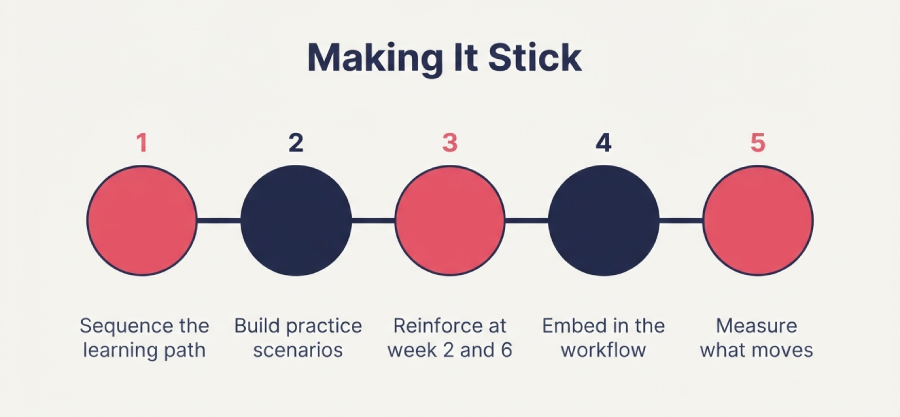
This one is for the L&D reader. If you have put sixty coaching questions in a deck and watched them come back unused, the problem is usually delivery design rather than the questions.
Sequence them across a learning path. Sixty questions in one workshop produces recognition, not recall. A path that introduces the seven core questions first, then one framework, then two situation sets a month later gets far more of the bank into circulation than a single day does.
Build practice scenarios for the awkward ones. Managers rehearse the easy conversations and improvise the hard ones. Conflict, underperformance and bad news need role-play, branching scenarios or recorded practice with feedback. Everything else can be self-directed. This is where new manager training tends to be thinnest, since most programs cover process before conversation.
Plan reinforcement for week two and week six. Week two is when the first attempt has gone badly and the manager is deciding whether to try again. A short prompt or a question of the week is enough. Week six is when the habit either exists or does not, so run the refresher on the questions the cohort is actually using rather than the full list.
Put the questions where managers already are. A PDF in the LMS gets opened once. The same question set inside the 1:1 template, the performance review form or the meeting agenda gets used weekly. Ship the job aid into the workflow and treat the course as the explanation, not the artifact.
Measure something that moves. Course completion tells you nothing about coaching. Three signals are usable: 1:1 consistency data from your calendar or HR system, the manager-effectiveness items in your engagement survey, and movement on the listening and development questions in your 360-degree feedback software. Take a baseline first. The usual reason these rollouts cannot prove anything is that nobody measured the starting point. Reverse mentoring pairs are a useful read too, since junior participants will tell you fast whether the questions are being used or performed.
Once these coaching questions are part of your 1:1s, the next gap is usually structural rather than personal. My guide to new manager training covers what to build around them for someone running a team for the first time.
FAQ
What are the 7 coaching questions?
There is no official set of seven, though several coaching books use the number. The seven that hold up across most workplace conversations are: What’s on your mind? What’s the real challenge here for you? What have you already tried? What does good look like here? What is getting in the way? What do you want to do next? What do you need from me?
What are the powerful questions in coaching?
Powerful questions are short, open and slightly uncomfortable. Most run under ten words and contain no suggestion. Examples: What’s the real challenge here for you? And what else? What are you assuming? What are you not saying? The power comes from the silence afterward, not the wording.
What are the 5 C’s of coaching?
There is no single agreed version. Providers list Clarity, Commitment, Confidence, Challenge and Change, or Competence, Confidence, Connection, Character and Commitment, among others. Treat any 5 C’s list as one provider’s checklist rather than an established model. For a framework with a documented origin, use GROW, CLEAR or OSKAR.
What are the 7 C’s of leadership?
This varies by source too. Common versions list Character, Communication, Courage, Collaboration, Consistency, Conviction and Competence, while others swap in Compassion, Connection or Commitment. It works as a memory aid, not a research-backed model, and it is not a coaching framework.
Do you need to be a certified coach to coach your own team?
No. Certification matters for external coaching practice and for internal coaches running formal, contracted assignments. Managers coaching their own teams need open questions, the discipline to stay quiet, and the judgment to recognize when a situation needs an instruction instead. Certification does not supply that last one.
What is the difference between coaching questions and mentoring questions?
Coaching questions are non-directive. They help someone find their own answer, and the coach does not need to have done the job. Mentoring questions come from experience and lead somewhere on purpose: “When I was in that role I did X, how would that work for you?” Managers do both in one conversation. Coach first, or the mentoring closes the thinking down before it starts.
Once these coaching questions are part of your 1:1s, the next gap is usually structural rather than personal. My guide to new manager training covers what to build around them for someone running a team for the first time.