

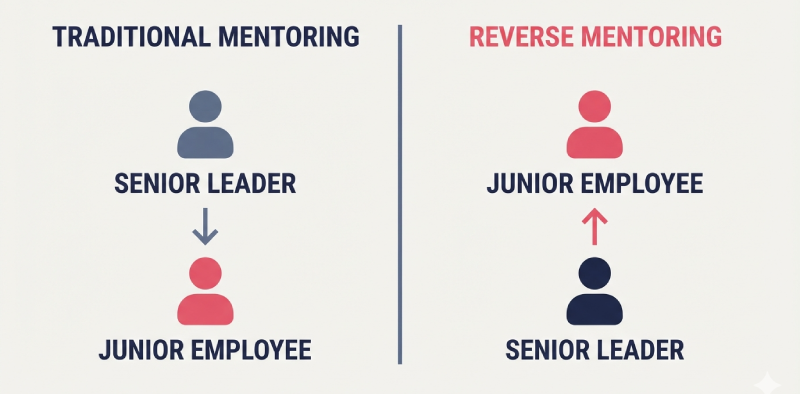
Reverse mentoring is when a junior employee mentors a senior leader, not the other way around. The idea traces back to 1999, when GE’s Jack Welch paired 500 executives with younger staff to teach them the internet. It has since grown into a real tool for closing generational gaps and building better leaders. Here is what reverse mentoring is, where it started, and how to launch a program that works.
What Is Reverse Mentoring?
Reverse mentoring is a mentoring relationship where a junior or younger employee acts as the mentor and a senior leader acts as the mentee. Some people call it reverse mentorship. Same idea, different name.
In a normal mentoring setup, an experienced employee guides someone newer to the company or the field. Reverse mentoring flips that. The junior person brings the expertise, often in technology, social platforms, or the lived experience of an underrepresented group. The senior leader shows up to learn.
A reverse mentor is not there to manage up or score points. Their job is to teach, share an honest perspective, and say what they actually see day to day. That honesty is where most of the value sits, and it is also the hardest part to get right.
I have sat in on a few of these pairings over the years, mostly as an observer helping a client set one up. The best ones felt like a real conversation between colleagues, not a training session with a title. The worst ones felt like a status update nobody asked for. The difference usually came down to whether the senior leader actually showed up ready to be taught.
Where Reverse Mentoring Came From
The story starts with Jack Welch, GE’s CEO in the late 1990s. In 1999, Welch paired around 500 senior executives with younger employees. The goal was simple: teach the old guard how to use the internet.
Welch later described it as tipping the organization upside down, with the youngest people teaching the oldest. The pilot worked well enough that GE kept running it, and other companies followed, including Cisco, Fidelity, and Target in the years since.
What started as a fix for one specific skills gap turned into something bigger. Companies realized junior employees had insight worth hearing on culture, diversity, and customer behavior, not just technology. That is why reverse mentoring is still around a quarter century later, long after everyone learned to use the internet.
I still think this origin story is the best sales pitch for the whole idea. A famously tough CEO admitted he did not understand something his own newest hires understood cold. He fixed the gap instead of hiding it.
How Reverse Mentoring Works
At its core, reverse mentoring runs on the same mechanics as any mentoring relationship, just with the roles swapped. Two people meet regularly. One shares knowledge. The other listens, asks questions, and applies what they learn.
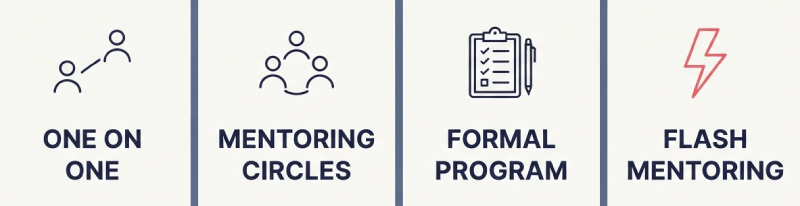
Programs take different shapes depending on the company:
- One on one pairings, the most common format, matching one junior mentor with one senior mentee
- Group mentoring, sometimes called mentoring circles, where a few junior employees meet with one or more leaders together
- Formal programs with a set structure, timeline, and defined goals
- Informal or flash mentoring, shorter and more ad hoc, often built around a single topic or question
Most programs that last land somewhere between fully formal and fully informal. Enough structure to keep people accountable. Enough flexibility that conversations stay honest instead of scripted.
Benefits of Reverse Mentoring
For Senior Leaders
Senior leaders get direct, unfiltered exposure to how younger employees think, work, and use technology. That is hard to get from a report or a slide deck.
Leaders also pick up practical digital skills, from new platforms to collaboration tools. And they get a clearer read on the generational and cultural shifts shaping their workforce and their customers. This kind of exposure pairs well with formal new manager training, since both aim to sharpen how leaders read and respond to their teams.
For Junior Mentors
Junior mentors get visibility they would rarely get otherwise. Sitting across from a VP or a CEO on a regular basis builds confidence fast.
It is also genuine leadership practice. Mentors learn to structure a conversation, give feedback upward, and hold their ground on a point they believe in. Several organizations link this experience directly to stronger employee retention, since participants feel seen at a level they usually do not reach. Teams already running 360-degree feedback software often fold reverse mentoring straight into that same feedback culture.
For the Organization
The company benefits too, in ways that show up in the numbers. Reverse mentoring supports retention, since participants at both levels tend to feel more connected to the culture.
It also strengthens diversity and inclusion work, since leaders build real relationships with mentors from different backgrounds. And it feeds innovation, because fresh perspectives get an actual hearing at the top instead of getting lost lower in the org chart.
Reverse Mentoring vs. Traditional Mentoring vs. Peer Mentoring
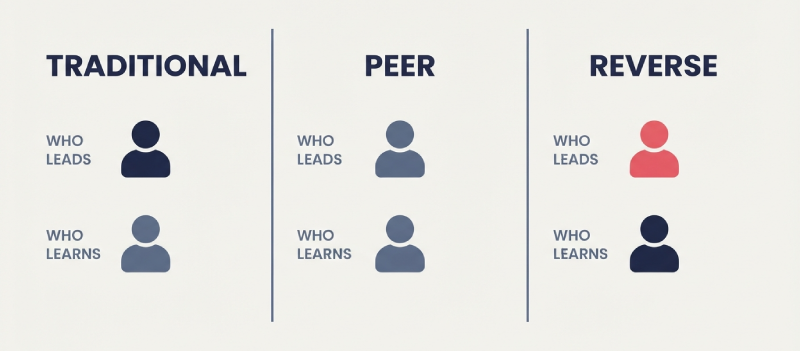
Traditional mentoring goes top down. A senior employee guides someone earlier in their career, usually on skills, strategy, or navigating the company.
Peer mentoring pairs people at a similar level or experience. They lean on each other for support, feedback, and shared problem solving.
Reverse mentoring goes bottom up. The junior employee leads the conversation, and the senior leader is there to learn. All three models can run at once inside the same company, and mentoring and reverse mentoring are often paired together as part of a broader development strategy. The main difference is direction. Traditional mentoring builds up the junior employee. Reverse mentoring builds up the senior leader, and often the junior mentor too.
Common Reverse Mentoring Topics
Reverse mentoring topics vary by company, but a few show up again and again:
- Technology and AI, including new tools and how younger employees actually use them day to day
- Social media and digital trends, especially where a company’s customers or candidates spend their time
- DEI and lived experience, giving leaders direct insight into challenges faced by underrepresented employees
- Generational communication, covering how expectations around work, feedback, and flexibility differ across generations
- Career expectations, since Gen Z and Millennial employees often want different things from work than Baby Boomers did
Good programs pick two or three of these per pairing rather than trying to cover everything. Depth beats breadth here.
A quick gut check before you pick topics: ask the junior mentor what they already get asked about informally, in the hallway or on Slack. Those questions are usually the real topics worth structuring a program around. If the format leans informal, the same logic behind good microlearning platforms applies: short, focused sessions beat long ones.
How to Start a Reverse Mentoring Program
I have watched programs launch with good energy and fizzle out within a few months. The ones that last follow a repeatable framework instead of running on good intentions alone, whether you are rolling this out standalone or bolting it onto existing employee training software.
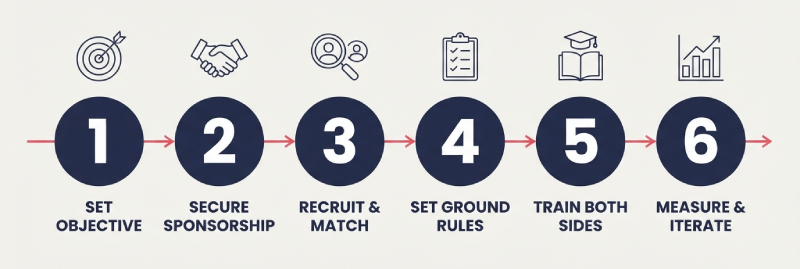
1. Set the objective. Decide what problem you are solving. A digital skills gap, DEI, retention, or innovation. The objective shapes everything downstream, from who you recruit to what you measure later.
2. Secure executive sponsorship. A program without visible leadership support stalls fast. Get a senior sponsor who participates publicly and holds other leaders accountable for showing up.
3. Recruit and match participants. Look for junior employees who communicate well and want the exposure, not just whoever is available. Match on relevant experience or background, not convenience, and ask both sides for input before finalizing pairs.
4. Set ground rules and cadence. Agree on meeting frequency, confidentiality, and what is off limits. A monthly cadence works for most programs. Weekly is usually too much for a senior calendar. Write the ground rules down somewhere everyone can find them. Some teams keep this next to their SOP software, others just use a shared doc.
5. Train both sides. Junior mentors often need coaching on how to give feedback to someone senior. Senior mentees need reminders that admitting a knowledge gap is the point, not a weakness.
6. Measure and iterate. Set a review point at three and six months. Ask what worked, what did not, and adjust before the next cohort.
For the practical side of running a program, a few tool categories can help, on top of whatever corporate training software you already run:
- Dedicated mentoring platforms such as Chronus, MentorcliQ, Mentorloop, Together, and Qooper, built specifically for matching, scheduling, and tracking mentoring relationships
- HR platforms with mentoring or performance modules, like Personio and similar all in one HR suites, useful if your people data already lives in one system
- An LMS with on the job training and communication features. iSpring LMS, for example, includes on the job training tracking and built in chats and comments, which some teams use to log reverse mentoring sessions and keep the conversation going between meetings. These sit alongside the other core LMS features worth checking before you commit to a platform.
None of these tools replace the relationship itself. They just make it easier to run a program at scale without losing track of who is meeting whom.
Common Challenges and How to Avoid Them
Senior discomfort. Admitting you do not know something is hard for people used to being the expert in the room. Reframe the relationship as mutual learning from day one, not a fix for the leader’s shortcomings.
Junior confidence gap. Junior mentors can feel awkward correcting or teaching someone several levels above them. Training and a clear mandate from leadership help here, and so does making the mentor’s role explicit and valued, not just tolerated.
Lack of structure. Programs that launch on good intentions with no framework tend to fizzle within a couple of months. Use the steps above, even in a lightweight form, rather than leaving pairs to figure it out on their own.
Proving ROI. This is the question every HR leader eventually asks. Does reverse mentoring actually work? The honest answer is that it works when leaders treat it as a priority and not a checkbox. Research on the topic points to one consistent failure mode: executives who do not prioritize the relationship. Protect the time on the calendar like any other commitment, and the results tend to follow. If you already track training spend, the same logic used to calculate LMS ROI applies here too.
I once sat in on a check in call where a VP admitted, on record, that he had never opened a Slack channel in his life. Nobody laughed at him. That is the whole point of a program that is working.
Real Reverse Mentoring Examples
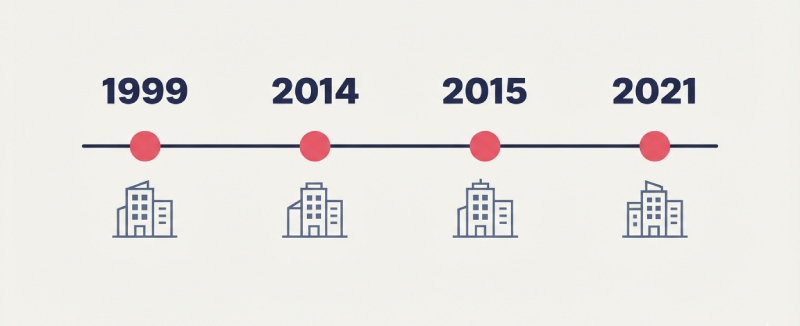
GE. The original. Jack Welch’s 1999 pilot paired 500 executives with junior staff to close a technology gap, and the model spread from there.
Estée Lauder. CEO Fabrizio Freda launched a formal program called the CEO Global Reverse Mentor Program in 2015. Junior participants went on to build Dream Space, an internal knowledge sharing portal that grew directly out of what they learned mentoring senior leaders.
PwC. PwC launched its reverse mentoring program in 2014 as part of a diversity and inclusion push. The program eventually grew to more than a hundred junior mentors paired with partners and directors around the world.
Heineken. Heineken has run a reverse mentoring program since 2021, connecting senior leaders with junior employees on consumer trends and digital habits. In an internal survey, most senior mentees said they wanted even more time with junior colleagues.
IBM. IBM has used reverse mentoring to give leaders in growth markets direct exposure to the experiences of LGBT employees, building more candid conversations about inclusion.
BNY Mellon Pershing. Facing high turnover among younger employees, Pershing built a reverse mentoring program aimed squarely at retention. The company later reported a 96 percent retention rate among the Millennial employees who took part.
These programs differ in size and focus, but they share a pattern. Each one started with a specific problem, not a general interest in mentoring for its own sake.
How to Measure Success
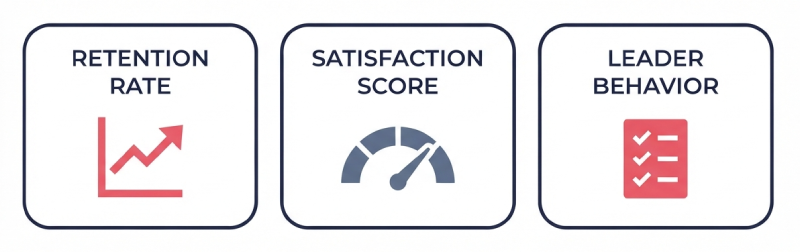
Retention comparisons are the clearest signal. Track whether program participants stay longer than similar employees who are not in the program, and check back at six and twelve months.
Satisfaction surveys matter too, for both mentors and mentees. Ask directly whether the relationship felt useful and whether they would recommend the program to a colleague.
Watch for behavior change in leaders as well. Are they referencing what they learned in meetings? Making different calls on hiring, product, or culture? That shift is harder to measure than a survey score, but it is often the real point of the program. If your program includes any formal sign off step, certification tracking software can handle the paperwork so you can focus on the relationship.
If you are building out a broader retention or onboarding strategy alongside this, our guide to employee onboarding programs is a natural next read.
Reverse mentoring will not fix every leadership gap on its own. But paired with the right structure, it remains one of the most direct ways to get senior leaders learning straight from the people closest to the work.
FAQ
Is reverse mentoring the same as regular mentoring?
No. Traditional mentoring flows from senior to junior. Reverse mentoring flips that, with the junior employee acting as mentor and the senior leader as mentee.
Does reverse mentoring actually work?
Yes, when leaders commit real time to it. Companies including Estée Lauder, PwC, Heineken, and BNY Mellon Pershing have run formal programs for years and report measurable results in retention, DEI, and leadership development.
How do you set up a reverse mentoring program?
Set a clear objective, get executive sponsorship, match participants carefully, agree on ground rules, train both sides, then measure and adjust. See the framework above for the full breakdown.
Who invented reverse mentoring, and where did it start?
Jack Welch, GE’s CEO, is credited with starting the practice in 1999. He paired around 500 senior executives with junior employees to teach the executives about the internet.
What topics work best for reverse mentoring?
Technology and AI, social media and digital trends, DEI and lived experience, and generational communication are the most common and effective starting points.
How long should a reverse mentoring program run?
Most formal programs run in cohorts of six to twelve months, with a review point around the three month mark to adjust pairings or structure before continuing.
Why do companies need reverse mentoring?
Because the people closest to customers, new technology, and shifting workplace expectations are often the least senior in the room. Reverse mentoring gives that insight a direct line to the people who set strategy.