
If you search for eLearning companies in the USA, you get a strange mix of businesses. Some sell learning management systems. Some build courses for clients. Others provide authoring software or huge libraries of ready-made training.
They all belong to the eLearning industry, but they solve very different problems.
I’ve updated this guide for 2026 to separate those groups and explain what each company actually provides. That should make it easier to build a shortlist without comparing an LMS vendor with a custom development agency as if they were the same thing.
eLearning companies in the USA: the short version
The right eLearning company depends on what you need it to do.
If you want to create courses internally, iSpring Solutions and Articulate are two established authoring options. iSpring also offers a full LMS for managing corporate training, while Articulate focuses more heavily on course creation and delivery.
For larger enterprise learning environments, Cornerstone and Docebo are more relevant comparisons, especially when the setup involves more complex administration, integrations, or several learner groups.
If the main job is custom eLearning development, companies such as ELB Learning, eLearning Solutions Company, AllenComm, Infopro Learning, and Aptara belong on a different shortlist.
For ready-made courses, compare providers such as Skillsoft, Coursera, Udemy Business, LinkedIn Learning, BizLibrary, and Traliant.
Top eLearning companies in the USA: quick comparison
| Company | Type | Core offering | US presence |
| iSpring Solutions | LMS and authoring software | iSpring LMS, iSpring Suite AI, course authoring | Virginia |
| Coursera | Course and content provider | Professional courses, certificates, enterprise learning | California |
| Skillsoft | Content and learning platform | Percipio, corporate training content, skills development | New Hampshire |
| ELB Learning | Custom development and learning technology | Custom eLearning, authoring tools, immersive learning | Utah |
| Articulate | Authoring software | Articulate 360, Storyline, Rise, course authoring and review | New York, USA |
| TalentLMS by Epignosis | LMS and learning software | TalentLMS, TalentLibrary, TalentCards, eFront | Georgia and California |
| Adobe | Authoring software and LMS | Adobe Captivate, Adobe Learning Manager | California |
| Blackboard | Learning platform | Blackboard LMS and higher education learning technology | Washington, DC |
| Udemy Business | Course and content provider | Business course library and skills training | California |
| LinkedIn Learning | Course and content provider | Business, technology, and creative courses | California |
| edX | Course and content provider | University courses, certificates, professional learning | Virginia |
| Absorb | LMS and authoring software | Absorb LMS and Absorb Create | Florida |
| eLearning Solutions Company | Custom development | Instructional design and custom eLearning production | New York |
| BizLibrary | Content provider and LMS | Corporate course library and BizLMS | Missouri |
| Infopro Learning | Learning services | Custom content, managed learning services, consulting | New Jersey |
| Aptara | Custom development and learning services | Digital learning development and content production | Virginia |
| Cornerstone | Enterprise learning platform | Learning, content, skills, and talent technology | California |
| AllenComm | Custom development | Learning strategy, instructional design, custom training | Utah |
| Traliant | Compliance content provider | Workplace compliance courses and LMS | New York |
| Docebo | Enterprise LMS | Learning management and extended enterprise training | Georgia |
What type of eLearning company do you need?
One reason this market is confusing is that very different businesses often get grouped together under the same label.
An LMS vendor, a custom development agency, a course library, and an authoring software company can all appear in the same search results, even though they solve very different problems.
I find it more useful to separate them by the job you need done.
LMS and learning platform providers
An LMS provider gives you the software to deliver courses, enroll learners, track progress, store training records, and report on results.
Some platforms extend far beyond that. They may cover customer education, partner training, skills, content management, social learning, or parts of talent management.
If your main question is “Where will our training live and how will we manage it?”, start with this category.
Custom eLearning development companies
An eLearning development company builds learning content for you.
These businesses may provide instructional design, course development, animation, video, simulations, localization, scenario-based learning, mobile learning, or conversion of existing materials into digital courses.
They make sense when you need extra production capacity or expertise rather than another software license.
eLearning content providers
Content providers give you courses that already exist.
A library can cover leadership, software, professional skills, workplace safety, cybersecurity, compliance training, or thousands of other subjects.
This route works particularly well when the subject is not unique to your company. You probably do not need to commission a custom course to teach Excel or basic project management.
Authoring and course creation software companies
Authoring software is for teams that want to build the courses themselves.
Your instructional designers, trainers, or subject matter experts create the content, while the software provides the tools for quizzes, interactions, video, simulations, publishing, and LMS compatibility.
iSpring, Articulate, Adobe, and several other eLearning software companies operate in this part of the market.
How I selected these companies
I did not want to turn this into another list of 30 or 50 company names.
For this 2026 update, I focused on companies that are still active, have a meaningful US presence, and offer something clearly relevant to organizations buying or building online training.
I also wanted the list to reflect the different ways companies actually use eLearning. That means including software vendors, course developers, content providers, and companies that cover more than one of those areas.
For “USA,” I have not limited the list to American-owned businesses. Global companies can qualify if they have an established operation in the country.
The aim was to keep the list current, varied, and useful rather than make it longer for the sake of it.
A few important changes since my previous list
The eLearning market has changed quite a bit since I first published this page.
eLearning Brothers is now ELB Learning. I have kept the company in the guide under its current brand.
Adobe Captivate Prime is now Adobe Learning Manager. Adobe still uses Captivate for its authoring product, so the two names should not be confused.
Blackboard is a standalone company again. Following Anthology’s restructuring, Blackboard emerged in early 2026 as an independent company focused on teaching and learning.
There is also a major change involving two companies already on this list. Coursera completed its combination with Udemy on May 11, 2026. I still cover Coursera and Udemy Business separately because buyers continue to encounter distinct products and content offerings under those brands.
I have also removed some names from the old list where I no longer think they add enough to a corporate buyer’s shortlist.
Now, here are the companies.
The best eLearning companies in the USA
1. iSpring Solutions
| Name | iSpring Solutions, Inc. |
| Solutions | Learning Management System; eLearning authoring software; course development software; assessment software; role-play authoring; screencast and video creation; microlearning; course development services |
| Address | 1800 Diagonal Road, Suite 600, Alexandria, VA 22314, USA |
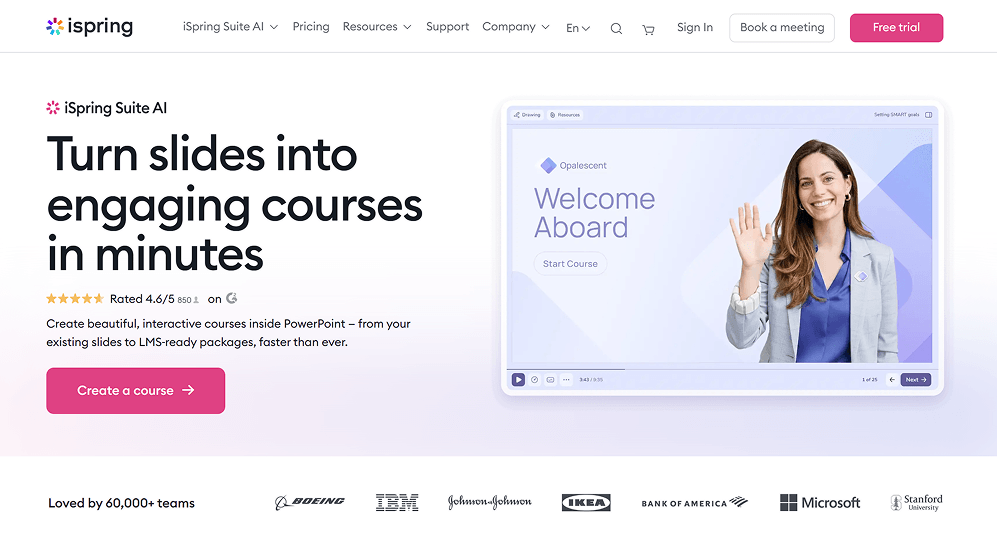
I put iSpring Solutions first because it covers two jobs that many corporate L&D teams need to solve together: creating training and managing it.
iSpring Suite AI is its authoring toolkit. It works with PowerPoint and can be used to create slide-based courses, quizzes, role-plays, screencasts, videos, and other interactive training. It publishes to standards including SCORM and xAPI. iSpring LMS handles learner management, assignments, learning paths, assessments, mobile learning, and reporting.
I like this combination for a team that wants to build a lot of company-specific training internally without maintaining a complicated collection of separate tools.
It is primarily a software company, though. If you want an outside agency to take over a large bespoke learning-design project, I would compare the custom eLearning development companies further down this list.
2. Coursera
| Name | Coursera, Inc. |
| Solutions | Ready-made online courses; professional certificates; enterprise learning; skills development; hands-on learning; university and industry content |
| Address | 2440 West El Camino Real, Suite 500, Mountain View, CA 94040, USA |
Coursera is a different type of eLearning provider from iSpring. The main attraction here is content rather than internal course authoring.
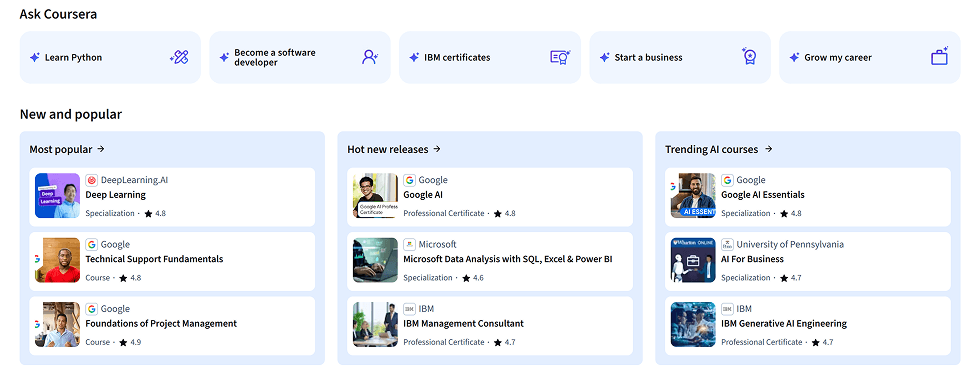
Coursera for Business gives companies access to professional learning from universities and industry partners. The enterprise offering includes courses, certificates, guided skills programs, and hands-on learning.
I would look at Coursera if the training requirement includes professional development, technology skills, leadership, data, or externally recognized credentials.
I would not use a course marketplace as the main answer to highly company-specific training. It cannot know your internal processes, products, or procedures unless you create that content elsewhere.
There is also a new ownership point to know. Coursera completed its combination with Udemy in May 2026, so the two businesses are now part of the same combined company.
3. Skillsoft
| Name | Skillsoft Corp. |
| Solutions | Percipio learning platform; ready-made corporate training; leadership and business skills; technology training; compliance training; certification preparation |
| Address | 300 Innovation Way, Suite 2210, Nashua, NH 03062, USA |
Skillsoft has been in corporate learning for a long time, and its biggest strength remains the amount and range of training content it can put in front of a workforce.
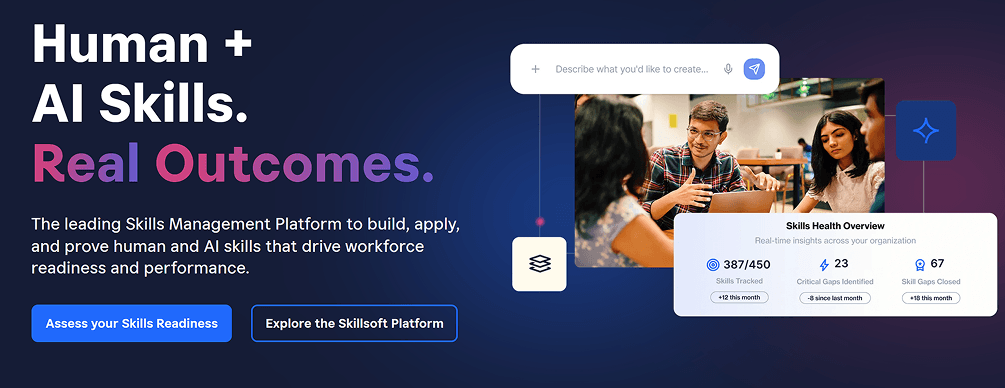
Its Percipio platform brings together learning material across leadership, business skills, technology, compliance, certification preparation, and other employee-development areas.
That makes Skillsoft a logical option if your company wants to give a large workforce access to an extensive content library without creating every course internally.
It is less useful as a substitute for custom eLearning development. A Skillsoft course can teach a common management or technical skill, but it will not automatically teach your company’s sales process or how employees operate your internal software.
For me, that distinction is important when comparing an eLearning content provider with an eLearning development company.
4. ELB Learning
| Name | ELB Learning |
| Solutions | Custom eLearning development; Lectora authoring software; CenarioVR; learning games; simulations; immersive learning; learning platform technology; staff augmentation |
| Address | 55 N. Merchant Street #1221, American Fork, UT 84003, USA |
If you remember eLearning Brothers from the earlier version of this article, this is the same business under its newer ELB Learning brand.
ELB is difficult to put into a single category because it combines custom eLearning development with learning technology. Its portfolio includes Lectora, CenarioVR, learning games, immersive learning tools, and custom production services.

I would look at ELB when the project calls for something more elaborate than a standard online course, especially simulations, interactive experiences, or outsourced production.
The size of that portfolio is also something I would clarify before buying. Make sure you know whether you need an authoring product, development services, a platform, or a combination. Otherwise, you can end up comparing several very different solutions under one company name.
5. Articulate
| Name | Articulate Global, LLC |
| Solutions | Articulate 360; Storyline; Rise; Review; Reach; eLearning authoring; responsive course creation; interactive courses; course review and collaboration |
| Address | 244 5th Avenue, Suite 2960, New York, NY 10001, USA |
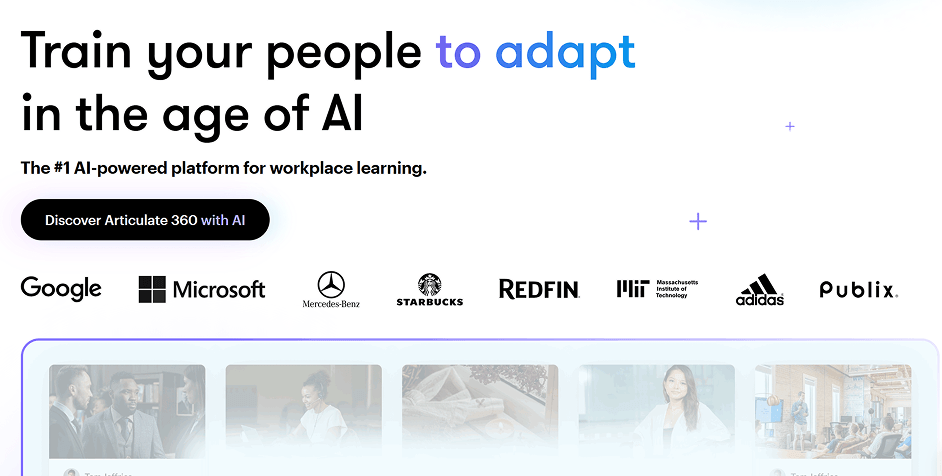
Articulate is one of the best-known eLearning software companies in the US, particularly among instructional designers and teams that develop courses internally.
Its Articulate 360 platform includes two very different authoring environments. Storyline gives course developers extensive control over interactions, variables, triggers, simulations, and visual design. Rise is browser-based and better suited to producing responsive courses quickly. The subscription also includes tools for review, collaboration, localization, and course delivery.
I would put Articulate on the shortlist when an internal L&D team wants substantial control over course design and expects to produce a steady stream of eLearning.
It is primarily a course-creation platform rather than a traditional corporate LMS. Reach can deliver and track training, but companies that need more extensive learner administration, training automation, compliance management, or enterprise reporting may still need a separate LMS.
6. TalentLMS by Epignosis
| Name | Epignosis LLC |
| Solutions | TalentLMS; TalentLibrary; TalentCards; eFront; Learning Management System; microlearning; ready-made courses; SCORM, xAPI, and cmi5 content delivery |
| Address | 505 Montgomery Street, 11th Floor, Suite 1100, San Francisco, CA 94111, USA |
Epignosis is the company behind several familiar eLearning products, with TalentLMS being the one most corporate buyers are likely to encounter.
TalentLMS covers the standard jobs expected from a cloud LMS, including course delivery, learner management, assessments, reporting, and integrations. The wider Epignosis portfolio also includes TalentCards and eFront.
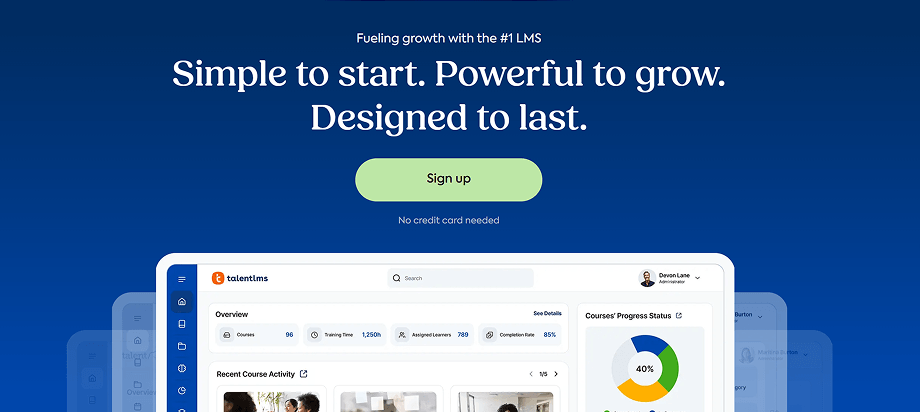
I would consider TalentLMS when a small or mid-sized company wants a relatively straightforward LMS rather than a much larger talent-management environment.
Epignosis has a clear US presence. In addition to the San Francisco address above, it lists an Atlanta office at 1201 Peachtree Street.
For buyers comparing content standards, TalentLMS supports common formats including SCORM, xAPI, and cmi5.
7. Adobe
| Name | Adobe Inc. |
| Solutions | Adobe Captivate; Adobe Learning Manager; eLearning authoring; Learning Management System; interactive courses; software simulations; xAPI and SCORM-based learning |
| Address | 345 Park Avenue, San Jose, CA 95110-2704, USA |
Adobe is obviously not an eLearning company in the narrow sense. Learning technology is one part of a much larger software business.
There are two products that make it relevant here.
Adobe Captivate is the authoring product used to create interactive eLearning and software simulations. Adobe Learning Manager is Adobe’s LMS for delivering and managing training.
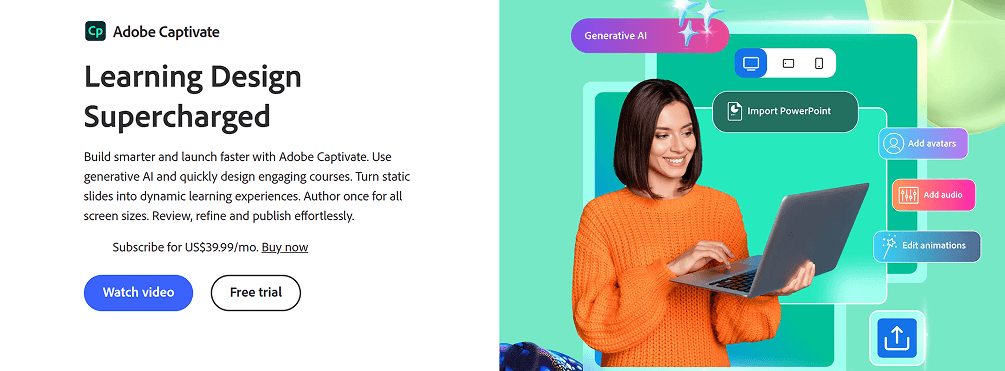
If you remember the old name Adobe Captivate Prime, that product was renamed Adobe Learning Manager several years ago. Adobe’s current documentation still makes that lineage explicit.
I would keep Captivate and Learning Manager separate in my head when evaluating Adobe. One creates learning content. The other manages learning. They solve different parts of the training process even though they come from the same company.
8. Blackboard
| Name | Blackboard |
| Solutions | Blackboard LMS; accessibility tools; course evaluation; institutional effectiveness; learning analytics; educational technology |
| Address | 1111 19th St NW, 8th Floor, Suite 801, Washington, DC 20036, USA |
Blackboard deserves a place here primarily because the search for eLearning companies is not limited to corporate training.
Its center of gravity is higher education. Blackboard LMS supports course delivery and teaching, while connected products cover areas such as accessibility, evaluation, and institutional effectiveness.
There has been an important company change since the earlier version of this article. Following Anthology’s restructuring, Blackboard became a standalone business again in 2026. Its current company information says the business is independently owned by Nexus Capital Management and Oaktree Capital Management.
If I were choosing software for a university, Blackboard would be a relevant comparison. For conventional employee onboarding or corporate compliance training, I would usually start with systems designed around business L&D.
Its current global headquarters is in Washington, DC.
9. Udemy Business
| Name | Udemy, Inc. |
| Solutions | Ready-made business courses; technology training; professional skills development; certification preparation; hands-on labs; enterprise learning |
| Address | 600 Harrison Street, 3rd Floor, San Francisco, CA 94107, USA |
Udemy Business takes selected content from the much wider Udemy ecosystem and packages it for organizational learning.
The appeal is breadth. Companies can give employees access to training across business, software development, IT, leadership, and many other professional subjects without commissioning those courses individually.
I would look at it for broad employee upskilling, especially when learners need many different technical or business subjects.
As with Coursera, it does not remove the need for internal content. A ready-made course can teach Python or project management, but it cannot explain your company’s procedures.
One major 2026 update is ownership. Coursera completed its combination with Udemy on May 11, 2026.
I have kept Udemy Business as a separate entry because it remains a distinct product and content proposition for buyers.
10. LinkedIn Learning
| Name | LinkedIn Corporation |
| Solutions | Ready-made courses; business training; technology training; creative skills; learning paths; professional certificates; certification preparation |
| Address | 1000 W Maude Avenue, Sunnyvale, CA 94085, USA |
LinkedIn Learning is one of the easier content platforms for employees to recognize before L&D introduces it.
The current library contains more than 26,000 courses and learning paths across business, technology, and creative subjects. It also includes professional certificates, certification preparation, exercise files, quizzes, and hands-on technical practice.
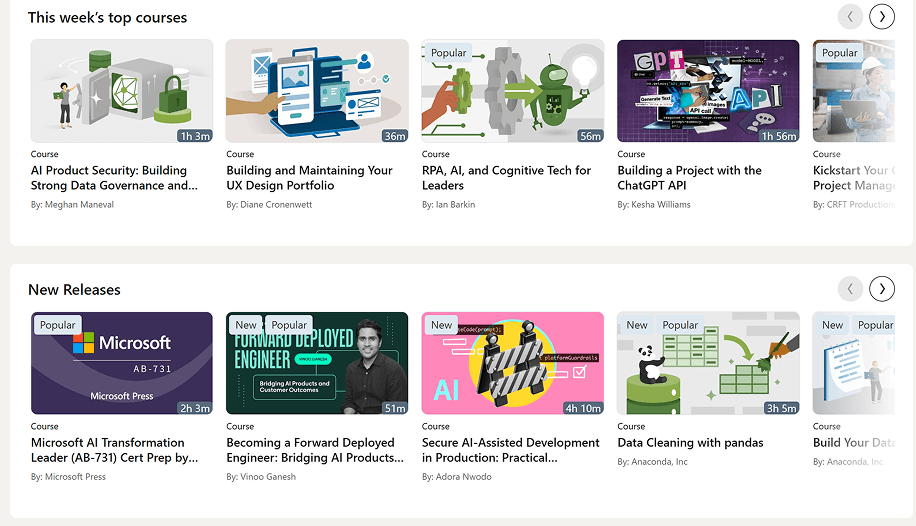
I see it mainly as an employee-development library. It works well when people need ongoing access to business software, management, communication, technology, creative, and professional skills.
It is not an eLearning course development company. You are buying access to existing content rather than hiring a team to design training around your organization.
LinkedIn lists its primary location at 1000 W Maude in Sunnyvale.
11. edX
| Name | edX LLC |
| Solutions | University courses; professional certificates; executive education; online programs; enterprise learning; course curation |
| Address | 2345 Crystal Drive, Suite 1100, Arlington, VA 22202, USA |
edX started with a strong university focus, and that remains an important part of its identity.
Today, the platform is owned by 2U and provides online courses, professional certificates, executive education, and other programs from universities and organizations.
For a corporate buyer, I would look at edX when employees need deeper professional or academic learning rather than short internal training modules.
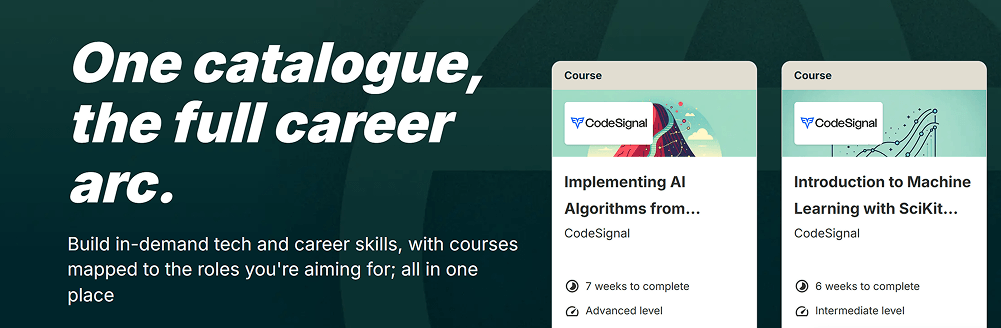
Like Coursera, it can complement a corporate LMS but does not replace the need for company-specific training content.
The current edX terms identify edX LLC at 2345 Crystal Drive in Arlington, Virginia.
That makes its US presence straightforward, even though the platform works with education partners and learners around the world.
12. Absorb
| Name | Absorb Software North America, LLC |
| Solutions | Absorb LMS; Absorb Create; employee training; customer training; partner training; online course management; learning analytics |
| Address | 19046 Bruce D Downs Blvd, Suite B6 #720, Tampa, FL 33647, USA |
Absorb is primarily a learning management system, with an authoring option available through Absorb Create.
The LMS can be used for internal employee learning as well as customer and partner training. Absorb Create lets licensed users build content within the same broader product environment.
One thing I would check carefully is which products are included in the package you are considering. Absorb’s own documentation describes Create as a paid feature that requires an appropriate license.
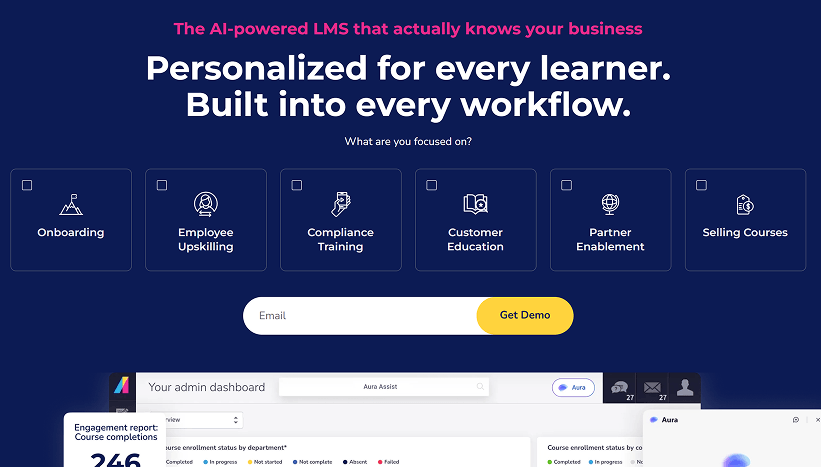
I would put Absorb on a mid-market or enterprise LMS shortlist when the learning program covers several audiences and needs more than simple internal course assignment.
Its Florida corporate record was updated in February 2026 and lists the Tampa address above for Absorb Software North America.
13. eLearning Solutions Company
| Name | eLearning Company, Inc., dba eLearning Solutions Company |
| Solutions | Custom eLearning development; instructional design; interactive courses; simulations; microlearning; localization; SCORM, xAPI, and cmi5 development; LMS and LXP integration |
| Address | New York, NY, USA |
The company previously appeared in this article simply as eLearning Company. It now uses the eLearning Solutions Company name.
This is one of the clearer examples of an eLearning development company rather than a software vendor.
Its team creates custom training and supports areas such as instructional design, multimedia, simulations, microlearning, course development, and LMS integration.
I would compare it when the problem is “we know what people need to learn, but we need somebody to design and build it.”
That is a very different purchase from subscribing to an authoring tool and asking your own trainers to create the courses.
The company supports common eLearning delivery standards including SCORM, xAPI, and cmi5, which is useful if the final course needs to run in an existing LMS.
14. BizLibrary
| Name | Business Training Library, LLC |
| Solutions | BizLibrary content library; BizLMS; employee training; compliance training; skills development; custom course creation; learning paths |
| Address | 14500 S. Outer Forty Road, Suite 412, Town and Country, MO 63017, USA |
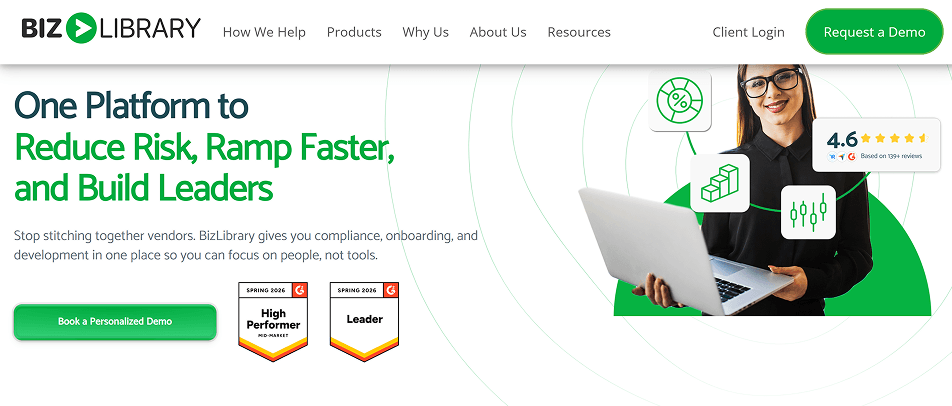
BizLibrary sits between two categories because it provides both training content and a learning platform.
Its content library covers corporate subjects such as compliance, leadership, workplace safety, communication, and employee development. BizLMS handles delivery, assignments, learner management, reporting, and internal content.
I can see the appeal for an HR or L&D team that wants a ready-made training library and the system to deliver it without buying them from separate vendors.
The limitation is the same one that applies to most content libraries. Your organization will still have subjects that nobody else can teach for you.
BizLibrary has added tools for creating company-specific material, but I would still decide early how much of your training will be bought and how much will be built internally.
15. Infopro Learning
| Name | Infopro Learning, Inc. |
| Solutions | Custom eLearning development; managed learning services; learning consulting; learning technology; training delivery; L&D staffing |
| Address | 4390 Route 1 North, Suite 302, Princeton, NJ 08540, USA |
Infopro Learning is broader than an online course development agency.
It works across custom content, learning consulting, managed learning services, learning technology, and additional L&D capacity.
I would consider it when a company needs ongoing help with the learning function rather than one authoring project.

For example, a large organization may need course development, administration, training operations, and extra specialists at the same time. That is where a managed learning services provider becomes a different proposition from a freelancer or an authoring tool.
For a smaller project involving five or ten courses, I would compare the scope and staffing model carefully. A large services provider may be more than the project calls for.
Infopro currently lists several US offices, including Princeton, New York, and Puyallup.
16. Aptara
| Name | Aptara, Inc. |
| Solutions | Custom eLearning development; learning design; digital learning resources; content development; simulations; mobile learning; content conversion; learning services |
| Address | 4501 Daly Drive, Suite 312, Chantilly, VA 20151, USA |
Aptara is another company I would look at when there is a significant content-production job to solve.
Its work extends across learning design, digital learning resources, content development, publishing and conversion, accessibility, and corporate learning.
That makes it particularly relevant when an organization has a lot of material to create, update, convert, or maintain rather than a single online course.
I would classify Aptara as a services company first. If your team simply wants software to make SCORM packages itself, compare authoring tools instead.
Aptara is headquartered in Chantilly, Virginia, and also lists US offices in the Boston and Austin areas.
17. Cornerstone
| Name | Cornerstone OnDemand, Inc. |
| Solutions | Enterprise learning; Learning Management System; skills management; learning content; talent development; workforce learning |
| Address | 1601 Cloverfield Blvd, Suite 600 South, Santa Monica, CA 90404, USA |
Cornerstone belongs at the enterprise end of this list.
Learning is part of a much wider workforce and talent environment, so I would consider it when L&D needs to connect closely with skills, employee development, and broader talent processes.
That makes it quite different from buying a standalone course library or a lightweight LMS.
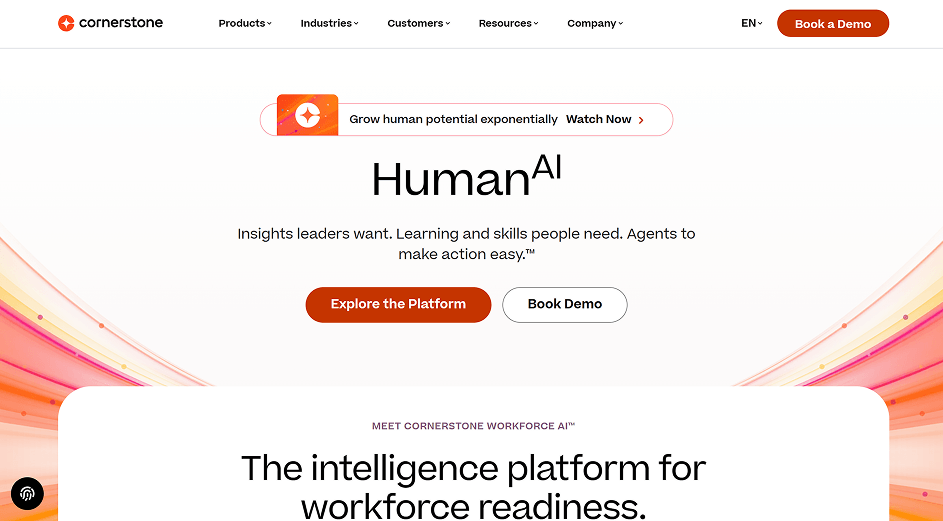
For a large international organization, that breadth can be a reason to include Cornerstone in an RFP. For a small training team that mainly needs to assign onboarding and compliance courses, it may mean evaluating a lot of functionality outside the original requirement.
Cornerstone still lists its global headquarters in Santa Monica, California, with additional US locations.
This is one of those cases where I would define the project scope before comparing feature counts.
18. AllenComm
| Name | Allen Communication Learning Services |
| Solutions | Custom eLearning development; instructional design; learning strategy; simulations; mobile learning; microlearning; learning technology; L&D staffing |
| Address | 55 West 900 South, Salt Lake City, UT 84101, USA |
AllenComm is a long-established custom training company rather than a conventional LMS vendor.
Its work covers instructional design, custom eLearning, simulations, mobile learning, microlearning, learning technology, and larger training initiatives.
I would look at AllenComm when the course itself needs serious design work, especially if the subject is technical, behavioral, or difficult to teach with a basic presentation and quiz.
The company also works on learning strategy and technology, so I would be specific about what I want the project team to own.
That is an important distinction with eLearning agencies. “Custom development” can mean anything from producing a course from a finished storyboard to researching the problem and designing the full learning experience.
AllenComm continues to list its Salt Lake City address in current company materials.
19. Traliant
| Name | Traliant Operating, LLC |
| Solutions | Compliance training; harassment prevention; workplace violence training; employment law; ethics and compliance; cybersecurity and data privacy training; Learning Management System |
| Address | 169 Madison Ave #2429, New York, NY 10016, USA |
Traliant is much more specialized than Skillsoft, LinkedIn Learning, or the other broad eLearning content providers in this guide.
Its focus is workplace compliance and risk. Current course areas include harassment prevention, workplace violence, employment law, ethics, inclusive workplaces, cybersecurity, and data privacy.
That specialization can make selection easier. If compliance is the main problem you are trying to solve, you can compare the actual course coverage rather than paying for a huge catalog of unrelated subjects.
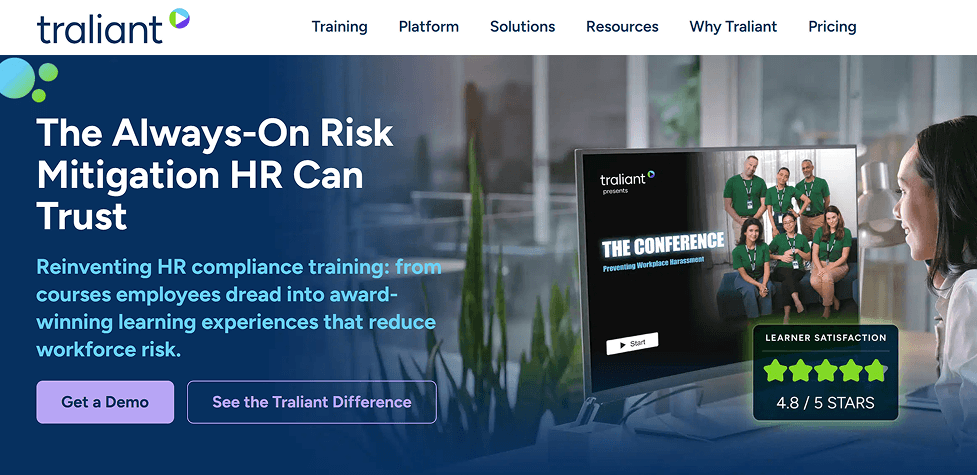
Traliant also has its own LMS, although organizations with an existing learning platform should check how the content can be deployed there.
I would not choose it as my general employee-development library. I would choose it because I specifically needed compliance content.
Its current mailing address is in New York.
20. Docebo
| Name | Docebo NA, Inc. |
| Solutions | Docebo Learn; Learning Management System; extended enterprise learning; customer education; partner training; social learning; learning communities; eCommerce |
| Address | 600 N. Thomas Street, Suite A, Athens, GA 30601, USA |
Docebo is another enterprise learning platform, and I would pay particular attention to it when training extends outside the employee population.
Its current offering includes Docebo Learn plus capabilities for extended enterprise learning, social and informal learning, communities, and eCommerce.
That gives it a natural place in customer education, partner training, dealer networks, memberships, and other cases where one organization needs different learning environments for different audiences.
If all you need is a simple internal LMS for a few hundred employees, I would compare the implementation and administration requirements with simpler systems.
For a larger extended-enterprise program, though, Docebo solves a different set of problems.
How to choose an eLearning company
There is a much easier way to make a shortlist than comparing every company above.
Start with what you need the provider to produce.
Do you need software or a service?
This is the biggest dividing line.
If you need a system for assigning courses and tracking learners, compare LMS vendors.
If you need somebody to design and build the course, compare eLearning development companies.
If your own team will create the courses, look at authoring software.
If you mainly need generic professional training, start with a content library.
Those are four different purchases.
Who will create your company-specific courses?
Even a very large ready-made content library will not cover everything.
Your onboarding, product knowledge, SOPs, internal systems, sales processes, and company policies usually need content created specifically for your organization.
Decide who will produce it.
That might be your own instructional designers, subject matter experts using an authoring tool, or an external eLearning course development company.
What does your existing technology require?
If you already have an LMS, check what the new content or software needs to work with.
For course packages, that may include SCORM, xAPI, cmi5, or another standard.
For a learning platform, look at HR systems, SSO, CRM connections, video tools, user provisioning, APIs, and reporting.
I would test the integrations that actually matter to the project rather than count logos on an integrations page.
Are you training employees, customers, or partners?
An employee LMS and an extended enterprise learning platform can look similar in a product comparison, but the administration can be very different.
Customer training may need self-registration, separate portals, branding, eCommerce, or CRM connections.
Partner training can require different organizations, permissions, certifications, and reporting.
Define your audiences before choosing the learning technology.
Do people learn away from a desk?
This matters if you are searching for mobile eLearning companies because your learners work in stores, warehouses, factories, hospitals, restaurants, or the field.
Do not settle for seeing a mobile-app icon on a vendor site.
Try the actual workflow. Check login, downloads, offline learning, course navigation, notifications, and whether progress synchronizes correctly after the learner reconnects.
How much content do you need to produce?
A company creating five high-profile courses has very different needs from a team producing 200 modules every year.
At higher volumes, authoring speed, templates, review workflows, localization, content maintenance, and internal subject matter expertise become much more important.
For outsourced work, ask how the eLearning development company handles updates after launch. A course is rarely finished forever.
What examples can the provider show you?
I would ask to see something close to the project I am buying.
For an LMS, ask to see the exact administrator and learner workflows your team will use.
For an authoring tool, build a small piece of your own content.
For an eLearning design company, inspect relevant course examples and ask who actually produced them.
For an eLearning content provider, open the courses. A catalog size tells you very little about whether people will want to complete them.
If you only need an LMS
LMS providers are only one part of the eLearning company market.
If you already know that you need a system for delivering, managing, and tracking training, I would skip the development agencies and content marketplaces here and go straight to my LMS providers in the USA comparison.
If you are earlier in the buying process, my How to Choose an LMS guide covers the requirements I would settle before starting vendor demos.
Final thoughts
The hardest part of searching for eLearning companies in the USA is not finding companies. It is working out which ones actually belong on the same shortlist.
An LMS vendor, an eLearning agency, an authoring software company, and a course library may all appear for the same search, but they solve very different problems.
I would start with the job that needs to be done. Do you need to manage training, create courses internally, outsource development, or give employees access to ready-made content?
Once that is clear, the list becomes much easier to narrow down. Compare companies within the same category, then look at the details that matter for your project, such as content standards, integrations, learner numbers, internal resources, and the amount of support you need.
FAQs
What are the best eLearning companies in the USA?
There is no one company that covers every type of eLearning project.
I put iSpring Solutions first for organizations that want both course authoring and an LMS. Cornerstone and Docebo are stronger candidates for large enterprise learning environments. ELB Learning, AllenComm, Infopro Learning, Aptara, and eLearning Solutions Company provide custom development services. Skillsoft, Coursera, Udemy Business, LinkedIn Learning, and BizLibrary focus heavily on ready-made learning content.
The first decision should be which type of provider you need.
What is the difference between an eLearning company and an LMS provider?
An LMS provider is one type of eLearning company.
It sells software for managing learners, courses, assignments, records, and reporting.
The wider eLearning industry also includes authoring software companies, eLearning content providers, custom course development companies, instructional design agencies, and managed learning services providers.
That is why I would not compare every eLearning vendor using one feature table.
Which eLearning companies build custom courses?
Companies in this guide that provide custom eLearning development include ELB Learning, eLearning Solutions Company, Infopro Learning, Aptara, and AllenComm.
iSpring also lists course development among its broader services, although I primarily regard it as an eLearning software company.
When comparing development vendors, ask how much of the instructional design, writing, multimedia, localization, testing, and project management they handle themselves.
Which companies provide ready-made eLearning content?
Skillsoft, Coursera, Udemy Business, LinkedIn Learning, BizLibrary, and Traliant all provide existing training content.
The libraries are not interchangeable.
Traliant specializes in compliance. LinkedIn Learning covers business, technology, and creative skills. Coursera includes courses and credentials from universities and industry partners. Skillsoft has a large enterprise-focused learning library.
Start with the subjects your workforce actually needs rather than the total course count.
Which eLearning companies offer authoring software?
iSpring Solutions, Articulate, Adobe, ELB Learning, and Absorb all offer authoring capabilities in some form. The products serve different users.
What should I ask an eLearning development company before hiring it?
I would ask to see relevant examples first.
Then find out who will work on your project, who owns instructional design, which authoring tools and standards they use, how reviews work, what localization they can handle, how source files are delivered, and what happens when a course needs updating six months later.
Also ask whether the examples in the sales presentation were made by the same team that would work with you.
Does an eLearning development company also provide an LMS?
Sometimes.
Some development companies also sell or configure learning platforms. Others build courses that are delivered through the client’s existing LMS.
Do not assume “eLearning solution provider” includes both.
Ask whether the proposal covers content creation, hosting, learner administration, reporting, platform implementation, and ongoing technical support. Those can be separate services.
What counts as an eLearning company in the USA?
For this guide, I include companies that are headquartered in the United States, have a meaningful US office, or have an established presence in the US eLearning market.
I have not assumed that every company serving American customers is American-owned.
That is also why I show the actual address in every company profile. If a global company does not currently list a US office, I would rather make that visible than imply otherwise.






Deep-learning AI is used by the Talent Intelligence Platform to assist each individual in understanding their career potential and helps each organisation understand the potential of its workforce. As a result, businesses have a better grasp of their own teams. AI in talent management may help you pinpoint your top and low performers and find the cause of any productivity disparities.
Hi, thanks for the addition!