
A SCORM package isn’t a regular video or document that you can simply open in a browser. To view the course properly, you need a SCORM player or SCORM viewer that can unpack the package, launch its content, and provide the SCORM environment the course expects.
Some SCORM players are designed for a quick preview, while others also let you inspect completion, scores, and communication between the course and the SCORM API.
Here are three options for different needs:
- SCORM Cloud — best for advanced testing and troubleshooting
- Teachfloor SCORM Player — best for quickly opening a SCORM file online
- RELOAD SCORM Player — a legacy option for running SCORM 1.2 packages locally
If your main goal is to troubleshoot tracking, completion, or reporting problems rather than simply open a course, see my guide on how to test a SCORM package.
| SCORM player | Best for | SCORM 1.2 | SCORM 2004 | Online | Free option |
|---|---|---|---|---|---|
| SCORM Cloud | Testing and debugging | ✓ | ✓ | ✓ | ✓ |
| Teachfloor SCORM Player | Quick online preview | ✓ | ✓ | ✓ | ✓ |
| RELOAD SCORM Player | Legacy/local SCORM 1.2 | ✓ | — | — | ✓ |
What is a SCORM player?
A SCORM player is software that opens and runs a SCORM package by providing the runtime environment the course normally gets from an LMS.
You may also see these tools called SCORM viewers. In practice, both terms are often used for tools that let you open and preview a SCORM .zip package without first publishing it to a learning management system.
More advanced SCORM players can also simulate the LMS API and show information such as completion status, scores, progress, and runtime communication.
Current player/viewer pages use this same distinction between simple viewing and simulated SCORM runtime behaviour.
1. SCORM Cloud
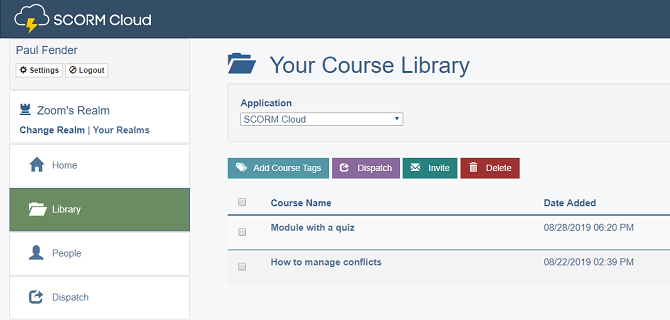
Since its initial launch in 2009, SCORM Cloud has gradually become the de-facto standard for SCORM testing in the e-learning world. Some folks use it to test SCORM packages and dispatch them to multiple LMSs. Meanwhile, other authors use it as an LMS and send invites to their users straight from the SCORM Cloud interface.
How it works
Using SCORM Cloud is easy: just sign up for a free account, and you get your own mini LMS to test SCORM files. It also works with AICC, xAPI and cmi5 packages.
After you upload a module, you can launch it in a popup window, test it, and then see your stats in the course sandbox.
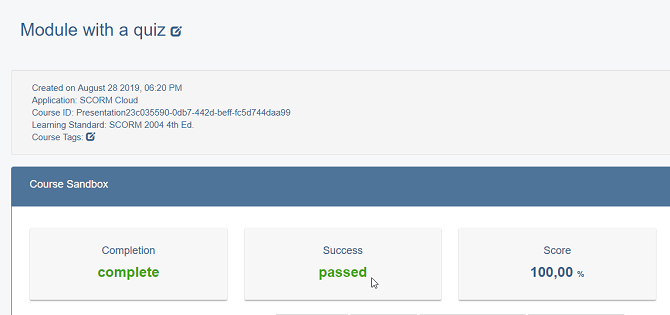
If you’re a developer or someone who wants to know how SCORM actually works, check out the Debug Logs. They’re detailed logs of the communications between your module and SCORM Cloud. It’s a useful feature that lets you debug SCORM content and understand the inner workings of the standard.
Additional features
- Invitations. You can invite learners via email to let them take your modules and see their stats on the Reportage screen.
- Dispatches. With this option, you can dispatch one e-learning module hosted on SCORM Cloud to several LMSs at the same time.
Pricing
SCORM Cloud has a free Trial that isn’t time-limited. It currently allows up to 3 courses and 5 GB of content, with 10 resettable registrations. You can reach either the course or storage limit first.
There is also a Tester plan for $40/month with unlimited storage and 10 resettable registrations.
Plans designed for delivering courses to learners start with Little at $90/month, which includes 50 new registrations per month and unlimited content storage.
Pros
- Free Trial has no time limit
- Supports SCORM 1.2/2004, AICC, xAPI, and cmi5
- Detailed debugging and runtime information
- Can be used for both testing and course delivery
- Cloud-based and works across operating systems
Cons
- Requires an account
- More complex than a simple SCORM viewer
- Free Trial is limited to 3 courses / 5 GB and 10 resettable registrations
- Paid plans can become expensive if you need many registrations
2. Teachfloor SCORM Player
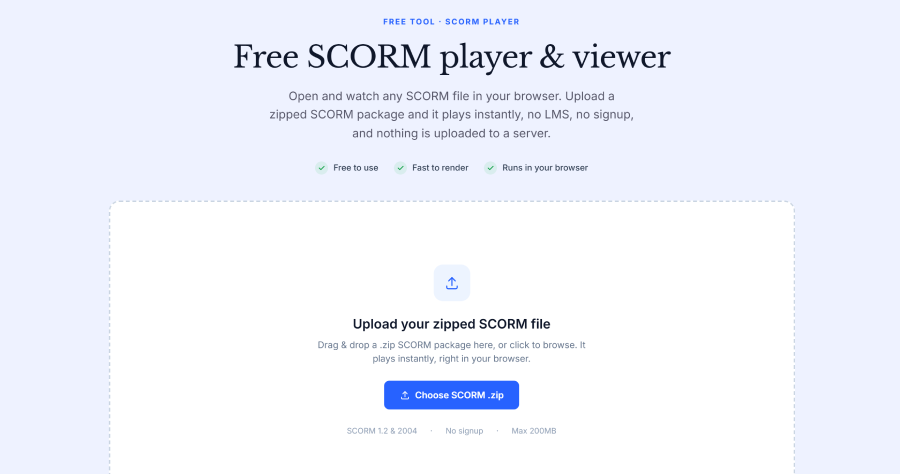
Teachfloor SCORM Player is a free online SCORM player and viewer for quickly opening a SCORM package without an LMS.
Unlike SCORM Cloud, it doesn’t require you to create an account or upload the course to a remote server. The package is unpacked and played directly in your browser.
It supports both SCORM 1.2 and SCORM 2004 packages.
How it works
Open the SCORM Player in your browser and select or drag in your zipped SCORM package. The package is unpacked locally in your browser rather than uploaded to Teachfloor’s servers.
This makes it particularly useful when you simply want to preview a course, test its navigation and interactions, or check what a SCORM package contains before uploading it to an LMS.
The current file-size limit is 200 MB.
Additional features
The player provides the SCORM runtime environment required to launch standard SCORM content, but it is intentionally much simpler than a full testing platform such as SCORM Cloud.
Pricing
Free.
Pros
- Free
- No account required
- Supports SCORM 1.2 and SCORM 2004
- Works directly in a modern browser
- Available on Windows, macOS, and Linux
- SCORM packages are processed locally in the browser
Cons
- 200 MB file-size limit
- Designed mainly for previewing rather than detailed SCORM debugging
- Some courses that depend on LMS-specific behaviour may not work exactly as they do in the final LMS
3. RELOAD SCORM Player
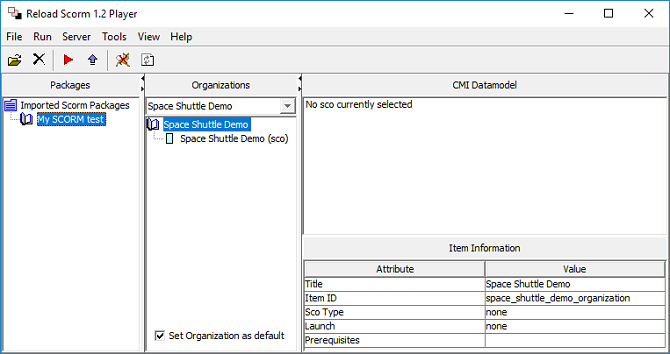
RELOAD SCORM Player is a legacy desktop SCORM player for running SCORM 1.2 packages locally. It’s particularly relevant if you’re working with older SCORM content or specifically searching for a downloadable SCORM 1.2 player.
The project dates back to the early 2000s and is no longer actively maintained. Its SourceForge project is currently marked Inactive, with the latest SCORM Player 1.2.1 source dating from 2005.
For that reason, I wouldn’t choose RELOAD for a new SCORM workflow today. However, it can still be useful if you specifically need a legacy local SCORM 1.2 player or are working with older learning content.
How it works
RELOAD runs the course through its own SCORM 1.2 runtime environment rather than requiring you to upload the package to an LMS or online service.
It includes a CMI data-model view, which allows you to inspect the information the course sends while it runs.
Additional features
Multi-SCO and organisations. RELOAD can work with packages containing multiple SCOs and SCORM organisations, which can be useful when examining older or more complex SCORM 1.2 packages.
Pricing
Free.
Pros
- Free
- Runs locally
- Supports multi-SCO SCORM packages
- Useful for legacy SCORM 1.2 content
Cons
- Supports SCORM 1.2 only
- No longer actively maintained
- Based on an old desktop/Java architecture
- Much less convenient than modern browser-based SCORM players
Can you open a SCORM file without an LMS?
Yes. An online SCORM player or viewer can unpack and launch a SCORM package directly in your browser, so you don’t need a full LMS simply to preview the course.
However, a player can’t guarantee that the package will behave exactly the same way in your LMS. If you’re preparing a course for deployment, you should still test it in the actual LMS before publishing it to learners.
This captures the “open SCORM file” intent without stealing the testing article’s topic.
Final Thoughts
For detailed SCORM testing and troubleshooting, SCORM Cloud remains the most capable option in this list. If you simply need to open and preview a SCORM package, a lightweight browser-based player such as Teachfloor is faster and requires no account. RELOAD is now mainly relevant for people working with legacy SCORM 1.2 content.
Whichever player you use, remember that previewing a course is not the same as testing it in its final LMS. If completion, scores, bookmarking, or reporting matter, run a final test in the LMS before publishing the course to learners.





Is it true that I can’t run a SCORM file without a SCORM player?
No! You can run a SCORM package right in your web browser. To do this, you just need to open your zip package and find a file named index.html, story_html5.html, or similar. After you click on it, a course will open in your browser.
You need a SCORM player if you want to not only play the content but also test if your SCORM package works properly or/and get statistics about the course completion results.
Please are these the only three available you can recommend?
You have made some good points there. I checked on the net to find out more about the issue and found most
people will go along with your views on this site.
Thank you for your comment!
Hi David,
I have an LMS already that has been on the market and used commercially for over 20 years in Australia. I only work in the Vocational Education area of Secondary Schools and Technical and Further Education Colleges.
I am looking to upgrade our offering to allow importing and running of SCORM 1.2 courseware in the WebTrain LMS. I understand the basics of what SCORM is but I have 2 questions.
1. Do I actually need a SCORM Player to run SCORM compliant courseware in our LMS or can I upload the SCORM file as a Course in our LMS and use our data capture etc. as it is being used now. Obviously, that would require us to be able to capture the data we need to run the courseware.
2. How easy is it to capture the required data from a SCORM compliant course once it has been unpacked and embedded into our LMS?
There’s a bit of work involved in research here but I’d appreciate any help you can throw my way.
Regards
Jim
David thanks for the nice article. Can we integrate a SCORM compliant module with a custom website or in other words can we make a custom website (PHP/MySQL) SCORM compliant. SCORM module is developed using Articulate Storyline software and is in .zip file format.
Hi David! I have a request from a customer which needs to run some SCORM courses completely offline… I’m trying to make the Reload SCORM Player work in Windows 10, with no luck… The Java plugin is running OK, but I got a message “Error opening native browser on Windows”… Did you have any tip on this?
Anyone using Reload SCORM Player in 2021?