In today’s fast-paced, technologically driven world, there has never been a greater need for effective, easily available, user-friendly learning solutions. The growing acceptance of smartphones and tablets has led to the emergence of mobile learning management systems (LMS) as a disruptive force in corporate and educational training.
In the guide below, we’ll look at the top-rated mobile LMS platforms with apps out there today. First, though, let’s discuss the features of a “good” adaptive learning management system.
Best LMS Software with Mobile Solutions: Quick Comparison Chart
| LMS | Type of solution | Distinctive features |
| 1. iSpring Learn | A corporate training and eLearning platform with a 30-day free trial that is used by clients in 172 countries. This mobile-friendly LMS comes optionally bundled with iSpring Suite for content authoring that’s simple, straightforward, and easy to customize. You can build custom learning tracks, control users and courses, and more. |
|
| 2. LearnWorlds | LearnWorlds is another popular mobile-friendly LMS that’s cloud based. This platform includes dynamic website builders and course creation tools, along with a white-label mobile app for complete customization. You’ll also find its eCommerce feature helpful for those who want to monetize their training courses. |
|
| 3. Docebo | Docebo offers two solutions that make it a strong contender: the Go.Learn native mobile LMS and Mobile App Publisher, which allows users to create and upload their own content. Courses can be created easily with drag-and-drop functionality. |
|
| 4. Litmos LMS | Litmos LMS is another feature-rich platform that connects learning through gamification and social engagement. This app has a large user database and makes many of the top LMS mobile app lists for a variety of reasons. Like Docebo, it comes with a content library and contains material that caters the needs of many different industries. |
|
| 5. Blackboard | Blackboard has been around since the early days of digital learning. It was originally created for government and education courses, but it has started offering solutions for business training as well. It does integrate with a lot of HR software, but Blackboard Learn will not integrate with AI, nor does it offer those features. |
|
| 6. Absorb | Absorb is on many “top LMS” lists, and for good reason. First, it offers online and offline accessibility, which is critical. It also has an easy-to-use interface that makes course creation and completion easy. The mobile app includes custom branding that is automatically downloaded. |
|
| 7. Sakai LMS | Sakai LMS is a feature-rich LMS that comes with all the resources you need for collaboration and learning. The open-source software is continuously improved and developed, making it easy to scale with your organization as you grow. The platform has been around since the early days of learning management systems, giving it staying power when compared to newer names in the industry. |
|
| 8. Moodle LMS | It’s another LMS with a mobile app that’s designed to deliver accessible, comprehensive learning. It includes tons of customization options and makes it easy for users to learn on the go. Moodle’s app can be downloaded on iOS and Android and it’s an open-source platform as well, which means you can customize and scale it to your heart’s content. |
|
Must-Have Features for a Mobile Learning LMS
Let’s explore the essential aspects of an LMS that help businesses successfully run training programs.
- Course management
The primary purpose of an LMS should be to facilitate the delivery of course materials to learners. Thus, choosing one that streamlines the course authoring process is crucial.
- Reminders and notifications
Including push notifications and reminders in your mobile LMS app is a great way to get even more out of it. Push notifications are the notices that pop up on your phone, such as those from your email inbox, text message service, or in this case, your learning and development app.
Additionally, you may provide them the option to sign up for extra notifications, such as email reminders, that will assist them in staying on schedule. The appropriate learning management system app will enable you to make any kind of communication tool and reminder.
- Responsive design
To provide a consistent user experience across smartphones and tablets, the LMS interface should be adjusted for different screen sizes and devices.
- Mobile app
It is imperative to have a native app compatible with iOS and Android. Compared to traditional training programs, LMS apps are more engaging and economical and improve information retention.
- Offline viewing
Having mobile devices allows you to potentially learn anywhere, at any time. They don’t require data to view content because they can access it even when you’re not within Wi-Fi signal range to download it. Users can download content to their devices and learn at their own speed using offline learning. As soon as the connection is restored, all exams, quizzes, and results will be entered into the system.
- Assessments and testing
You may develop and administer examinations, quizzes, and other assessments with the built-in features found in the best mobile learning management systems (LMS).
- Compatibility of course content
Verify that the learning management system (LMS) apps can handle a variety of content formats, such as presentations, interactive modules, videos, documents, and quizzes, and that it can support them on mobile devices.
- White-labeling
White-labeling is an option to take an LMS one step further when just branding it is insufficient.
Between an off-the-shelf system and a completely custom one is a white-labeled LMS. When choosing an LMS, consider whether the white-label capability is a “nice-to-have” or a “need-to-have,” as it varies throughout suppliers.
- Integrations
You can automate tasks like user creation and access, data synchronization, enrolments, and more by having a solution that interfaces with the software you already use (like an HR system, CRM, or webinar tool). For instance, using Single Sign-On (SSO), your students just need to log into one platform like Google Suite to be safely logged into your learning management system.
Additionally, you can push and pull data directly into and out of your LMS if the solution offers a RESTful API or is integrated with Zapier. After that, this can be used to enroll users in courses, establish and add people to groups, and send data back to systems owned by third parties.
- Automation
By eliminating tedious administrative activities with LMS automation, you may spend less time micromanaging training.
The Best LMSs with Mobile Apps
Here is a quick overview of the top mobile learning management systems in 2024.
1. iSpring Learn
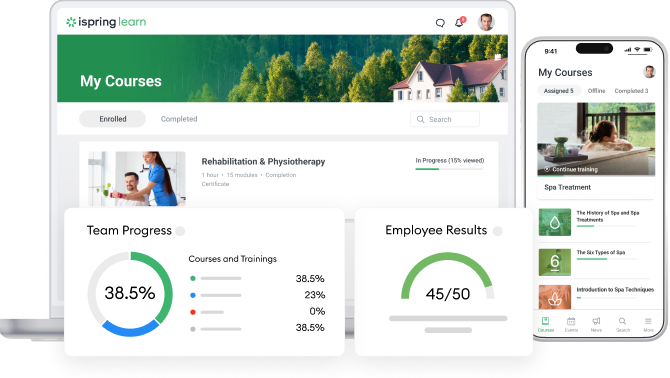
iSpring Learn is a corporate training and eLearning platform with a 30-day free trial that is used by clients in 172 countries. This mobile-friendly LMS comes optionally bundled with iSpring Suite for content authoring that’s simple, straightforward, and easy to customize. You can build custom learning tracks, control users and courses, and more.
Top Features
Step-by-step navigation: To allow readers to go deeper into the content gradually, you might segment your lengthy piece into chapters. If you believe that your information should be read in a specific order, you can, by the way, restrict navigation.
Comprehensive viewing statistics: You can simply track who has read the article and how far they have advanced using iSpring Learn.
Responsive design: To help the article become a natural extension of your company’s knowledge base, you can design it using your brand’s colors and typefaces.
Unlimited storage space: There are no restrictions on the quantity of hosted files with iSpring Learn. Thus, go ahead and upload as much content as you like.
SCORM support: Whether produced using the iSpring Suite or other third-party tools, all SCORM 1.2 and SCORM 2004 material is flawlessly registered and managed in iSpring Learn.
Why choose iSpring Learn
- Intuitive, modern interface that can be mastered quickly
- Easy-to-use and efficient user administration
- Learning tracks enable the learning process to be automated.
- An integrated quiz creator and course builder
- User roles that are adaptable to different kinds of organizations
- Excellent technical help available around the clock
- Attractive mobile application that offers offline learning in addition to desktop version capability
- Leaderboards, points, and badges are used in gamification.
- Strong corporate site features: newsfeed, public profiles, automated birthday wishes, interactive org chart, and new hire announcement
- Integration with the most well-liked CRM, HRIS, eCommerce software, web conferencing solutions, and calendars Integration with iSpring Suite guarantees you can create rich training content that will function as envisioned in the LMS
- Possesses an API that allows for platform integration
- A 360-degree feedback appraisal is used to assess the competencies of employees.
- Module for on-the-job training
- Pre-made internet courses
Pricing
iSpring Learn comes in two pricing plans: Start ($2.29 USD per user/month) and Business ($3.14 USD per user/month). A free 30-day trial is available.
The Verdict
iSpring Learn offers everything that you might need from a mobile LMS for corporate training. It includes resources for everything from onboarding to compliance and sales training, customer and partner training, and more. With smart management features and automated data syncing, your LMS will run itself. Book a live demo or check out a free trial of iSpring Learn now.
2. LearnWorlds
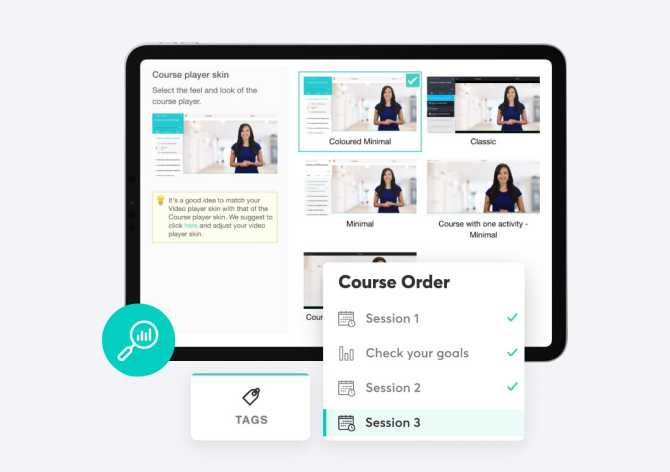
LearnWorlds is another popular mobile-friendly LMS that’s cloud based. This platform includes dynamic website builders and course creation tools, along with a white-label mobile app for complete customization. You’ll also find its eCommerce feature helpful for those who want to monetize their training courses.
Top features
100% White-label – Enable white labeling and entirely rename your Learning Management System!
No coding is required. Create a professional-looking mobile app with our simple click-and-edit visual builder. You can create and manage your courses from your dashboard without having to know how to code.
Visual Editor – Provides a revolutionary way to developing and distributing online video content that is based on proven educational research, elegant design, and reliable technology.
Push notifications are an incredible approach to boosting user engagement and customer retention. They are a noninvasive way to update users on what’s new and urge them to continue learning.
Why choose LearnWorlds
- Course Development and Customization: The process of producing interesting and interactive content is made easier with LearnWorlds’ intuitive and user-friendly course builder. You can easily organize your course material, include multimedia, include quizzes, and lead discussions with the drag-and-drop interface. This adaptability guarantees that teachers can create classes that meet their unique content requirements and instructional philosophies.
- Engaging video player: One of the platform’s most notable features is its sophisticated video player, which lets content producers improve the educational process. The video player’s interactive features, which include pop-up questions, debates, and multimedia attachments, actively engage learners. This produces a dynamic and engaging learning environment and improves comprehension.
- White-labeling and branding: LearnWorlds knows how crucial branding is to establishing a polished and well-organized learning environment. White-labeling options allow users to personalize the look and feel of their virtual school. This entails selecting a color scheme that complements their business identity, adding their logo, and using a custom domain. This characteristic guarantees a smooth integration of the learning platform with the brand’s overall image.
- Marketing tool: LearnWorlds provides a full range of marketing and sales solutions to empower users. Built-in landing pages simplify displaying and promoting courses, and targeted advertising campaigns are made easier by a smooth interaction with email marketing platforms. With the flexibility of creating coupons, discounts, and course packages, instructors can draw in and keep a wide range of students.
Pricing
The first serious plan on LearnWorlds is the Pro Trainer, which unlocks many useful features and limits. You pay $79/month (yearly) or $99/month (monthly). This is a fair price for a complete course platform.
The Verdict
LearnWorlds is one of the most dynamic mobile LMS options out there today. It offers so many features that it beats many competitors when it comes to comprehensiveness. Its interactive learning and high-quality assessment builder make training and education a breeze. Plus, there are packages for everyone, from small startups to corporate organizations and beyond.
3. Docebo
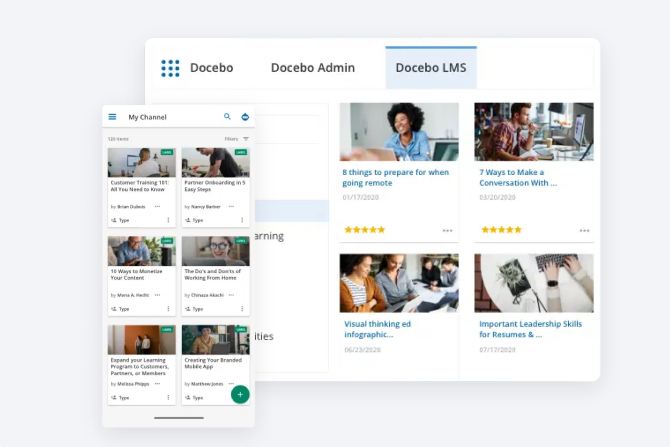
Docebo is fully customizable, allowing you to white-label a mobile learning management system for your specific needs. It’s ideal for organizations that have 300+ employees, offering impressive AI that can personalize experiences and streamline course creation.
Docebo allows you to create a branded mobile app that you can personalize to your liking. The app allows users to self-enroll, authenticate using biometrics, access information offline, and share it with others.
Top features
External Training: The External Training App allows users to upload external activities and certifications into the platform, which administrators can import and review.
White-labeling: Unlock white labeling options and completely rename your Learning Management System!
Notification: Create automated rules to alert your users of key events.
Gamification: Administrators can use this App to create badges – or awards – for learners to receive for completing tasks within the LMS. Gaining these badges generates a ranking for each user.
Administration Assistance: With Docebo’s extensive backup support and simple reporting services, education administration is simplified.
Learning Plan: Create learning plans by organizing a specified sequence of courses.
Why choose Docebo
- Docebo offers off-the-shelf content: Docebo, a feature-rich LMS, has a content library with off-the-shelf content and allows you to embed training into the employee workflow using its Flow capability.
- Review your data with Learning Analytics: Your learning programs create large amounts of data. Docebo Learning Analytics provides the tools you need to collect and analyze all of that essential information automatically.
- Excellent array of third-party integrations: Enhance your Docebo platform with seamless, flexible integration solutions tailored to your specific business requirements.
- Customer support: Customer support is available 24/7, and the response will nor make to wait much.
Pricing
Docebo (which begins at $1,600 per month) and its competitors LearnUpon, Mindflash, and WizIQ, is better for companies that directly conduct training sessions.
The Verdict
Docebo offers a dynamic option for a mobile LMS if you have a larger organization. Even with custom pricing, it’s still easy to reach out and they’re very “no pressure” about helping you conceptualize and price a solution. With personalized learning paths and AI to help make things simpler on both ends, it really offers something for every need. It may be too complex and costly for smaller organizations, but large companies find it very advantageous.
4. Litmos
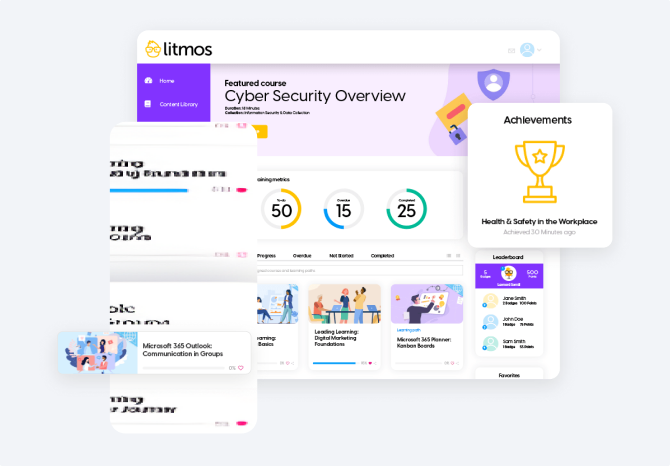
Litmos LMS is a feature-rich mobile learning management system that combines virtual, classroom, mobile, and social learning with gamification capabilities, built-in content production, and task automation. It includes a library of ready-made content and learning materials for various training themes.
Litmos is fully customizable in terms of branding and user interface flow. It also interfaces with workflow tools, allowing you to include training in your employees’ daily tasks. It has readymade e-commerce functionalities and interacts with Shopify.
Top features
iOS and Android app: Litmos provides the Litmos Training mobile app for iOS and Android, which includes downloading training and offline viewing.
Content library: When the course/learning path’s settings are configured so that the item is available in the Content Library, learners can use the Content Library tab to search for and self-enroll in courses (or learning pathways).
Content authoring tool: The Litmos content authoring tool enables users to generate visually appealing digital eLearning content for the LMS. Litmos LMS was designed to allow newbie content creators, high-end instructional designers, and everyone in between to create highly engaging content that will aid in any organization’s educational goals.
Social learning & gamification: Gamification is typically implemented using a learning management system (LMS). An LMS is a strong software capable of supporting a wide range of technologies. Your users will all access the content using the same site. Administrators will have the same access to edit content, create reports, and view how users performed on assessments within the content.
Litmos push notifications: Litmus Personalize tags can be used in push notifications to deliver automated, personalized, and relevant material. You can use the image source from Litmus Personalize in your Rich Push notification builder.
Why choose Litmos
- Rapid deployment and easy integration: Install in minutes instead of months, then interact with the rest of your ecosystem with ease. Select from over thirty pre-built connectors or create your own using open APIs.
- Integrated content creation: Within the LMS, create dynamic, visually appealing, and mobile-responsive SCORM material. This removes the expense and inconvenience of using external content development software and is designed to serve trainers of all skill levels, from novices to skilled instructional designers.
- Prefabricated content repository: It is constantly up-to-date, consistently applicable, and instantly usable in any LMS. Get ready-to-access courses in social skills and communication, leadership and management, compliance, and more.
- Quick and automatic onboarding of users: With single sign-on via integrated systems, an easy-to-use user interface, and automated email invitations, you can get students started right away. Establish rules to allocate teams, courses, and learning pathways automatically.
- Unlimited worldwide scalability: Expand your solution to millions of users worldwide. You can even begin small and grow as your business demands, making adjustments as you add more learners or branch out into other business ventures.
Pricing
Starting at $6 per user (for 150 to 500 active learners), per month, the SAP Litmos Pro subscription needs at least 150 active learners. Larger organizations get a better deal on this (for 501 to 1,000 active learners) since the cost is $4 per user per month.
The Verdict
Since Litmos offers a 14-day trial, it’s a great way to test the platform and see how it works for you. There are three packages available, but pricing information is not readily offered. It has a robust offering even without the white-label option, making it a solid choice for anyone who needs a reliable mobile learning management system.
5. Blackboard Learn
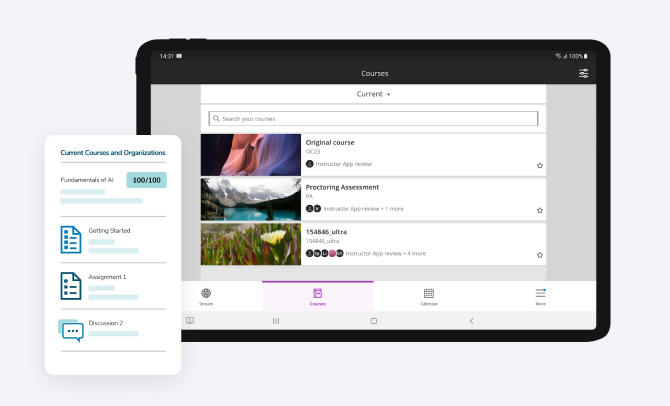
Blackboard has been around since the early days of digital learning. It was originally created for government and education courses, but it has started offering solutions for business training as well. It does integrate with a lot of HR software, but Blackboard Learn will not integrate with AI, nor does it offer those features.
There is a dedicated app for users that includes in-app messaging and access to downloadable content, assessments, and grades. Push notifications can be delivered in real time and information syncs once you reconnect.
Blackboard Learn is a bit outdated compared to other tools on the list. However, its versatility and longstanding reputation make it popular with many organizations. There are better, more modern tools out there for corporate training, but the familiarity of Blackboard often keeps people coming back.
Key Features of Blackboard Learn
- Integrates with HR software
- One of the oldest LMS platforms
- Reliable online and offline features
- The Blackboard Learn app makes learning on the go a breeze
Pros
- Versatile platform for several industries and uses
- Extensive collaboration and learning features
- Notification options make reminders easy
Cons
- No AI integration or optimization
- Outdated, interface that’s difficult to use
- No white labeling available for the mobile app
The Verdict
For those who have always used it, Blackboard Learn continues to deliver. It comes with a 30-day trial so you can check it out, but it might not be the right fit for everyone. Smaller organizations will probably find that this tool is a little too outdated and unfriendly, and pricing information isn’t readily available. The bottom line? It could be a good choice, but it might not compare to other options here.
6. Absorb LMS
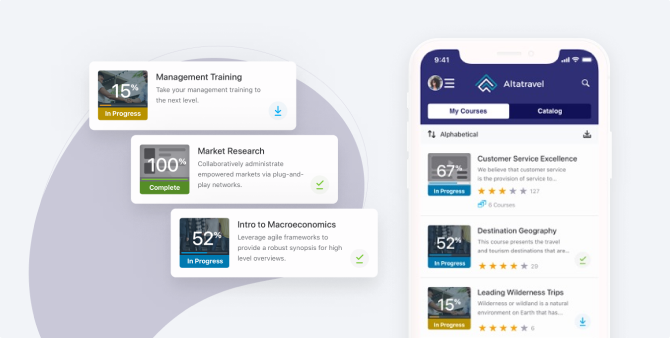
Absorb is on many “top LMS” lists, and for good reason. First, it offers online and offline accessibility, which is critical. It also has an easy-to-use interface that makes course creation and completion easy. The mobile app includes custom branding that is automatically downloaded.
Absorb LMS also has a responsive web interface, which means you can access it on desktop and mobile devices alike. It’s a more expensive solution, which makes it best for large organizations. However, it comes with robust AI features and delivers personalized learning experiences.
This platform also includes apps for iOS and Android. You can sync information offline, too, so people can learn anywhere. There are separate portals for learners and authors/admins, and the site and app design are focused on delivering the best experience.
Key Features of Absorb LMS
- Intuitive interface for easy navigation on any device
- Automatic allocation of coursework
- Self-paced learning supported
- Dedicated portals for users and authors
Pros
- Offline accessibility
- Easy course creation
- AI makes personalization easy
- Impressive site design
Cons
- High cost compared to other options
- Setup and configuration might be complex
- Users need to re-enroll every time a course is modified
The Verdict
Absorb LMS is a powerful learning tool indeed. However, because it’s priced at $14,500 per year, it may be limited to larger organizations and companies. The platform includes AI and all the features you could ever want, along with the option to create a totally engaging, personalized learning experience for each user. If you’ve got the budget, this mobile LMS could be the right fit.
7. Sakai
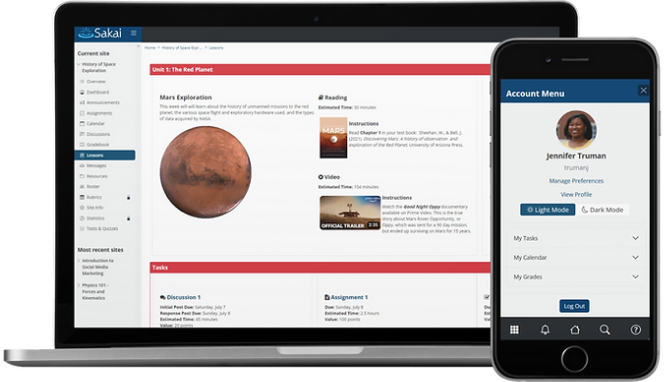
Sakai LMS is a feature-rich LMS that comes with all the resources you need for collaboration and learning. The open-source software is continuously improved and developed, making it easy to scale with your organization as you grow. The platform has been around since the early days of learning management systems, giving it staying power when compared to newer names in the industry.
The Sakai platform is flexible, so you can create your own learning architecture. It has a simple design that offers user-friendliness for learners. Navigation is a bit clunky compared with other tools, but you can sort things into files and create a file system to track your courses.
Sakai doesn’t integrate with all tools, nor does it offer a lot of AI when compared to other platforms on this list. It works through root navigation (think Windows Explorer), but customization makes it easier to navigate.
Key Features of Sakai
- Open-source platform
- Reliable service and support
- Automatic roster additions
- Highly customizable and easily automated
Pros
- Specifically designed for higher education
- Open-source platform offers full customization
- An active development and improvement community
- Integrates with other educational tools and solutions
Cons
- Slightly larger learning curve due to its academic focus
- May perform slower than other LMS platforms
- Technical sophistication may be a bit outdated
The Verdict
Sakai is a great choice for those who need a straightforward open-source LMS. It’s popular because its nature gives students and course authors more control over how the platform is developed. Some of the tools and navigation features could be updated, and the price is right (open source = free).
8. Moodle LMS
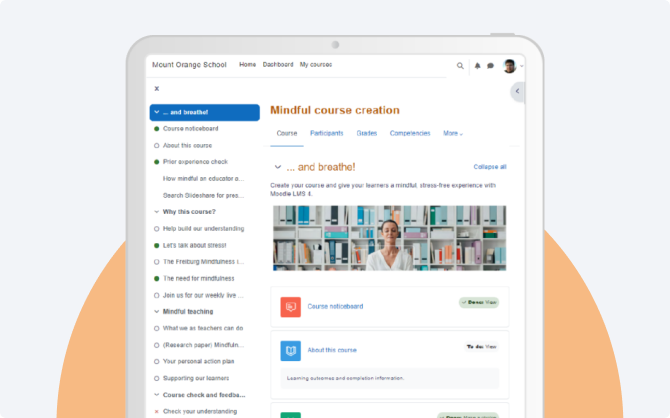
We can’t finish this list without mentioning Moodle. It’s another LMS with a mobile app that’s designed to deliver accessible, comprehensive learning. It includes tons of customization options and makes it easy for users to learn on the go. Moodle’s app can be downloaded on iOS and Android and it’s an open-source platform as well, which means you can customize and scale it to your heart’s content.
Moodle comes with a vast library of themes and plug-ins to allow you to create unique learning experiences for users. It also has a large community of users and supporters who continually offer development and resources. It has a steeper learning curve because it’s so customizable, but it’s worth a look if you like the idea of open-source platforms.
Moodle prides itself on data security and privacy. The UI is a bit outdated, but it’s still fairly simple and straightforward. Notifications are available in real time and you can even use the web conferencing feature for meetings, live training, and more.
Key Features of Moodle
- Partner integrations make content creation a breeze
- Multi-device support makes it accessible from any device
- Meets compliance standards for open-source software
- 1,600+ plug-ins for total customization of learning modules and training
Pros
- Plenty of notifications
- Offline learning opportunities
- Open-source means the price is right
- Supports LTI (Learning Tools Interoperability) for integration with education tools
- Tons of customization and scaling options
Cons
- Limited reporting features
- Course tracking and schedule management are lacking
- The outdated UI is a bit clunky
The Verdict
If open-source is the name of the game, Moodle gets the job done. This robust platform is a great competitor for other open-source tools and even gives other LMS apps a run for their money. Although the reporting is a bit simple and there is room for improvement, there’s also a dedicated community constantly making those improvements. It’s free for basic use and paid plans offer even more customization, making it worth a look.
Final Thoughts: Which Mobile Learning LMS Is the Best?
As you can see, there are a lot of top-rated options for a mobile-friendly LMS nowadays. Depending on the features you most want and what kind of learning you’re creating, any of the products on this list would do well. Remember to look for a platform that includes the features that matter to you.
Take advantage of demos and trials to see how things work firsthand. Ultimately, you should have no trouble finding the perfect solution, whether it’s on this list of the best mobile LMSs or elsewhere.